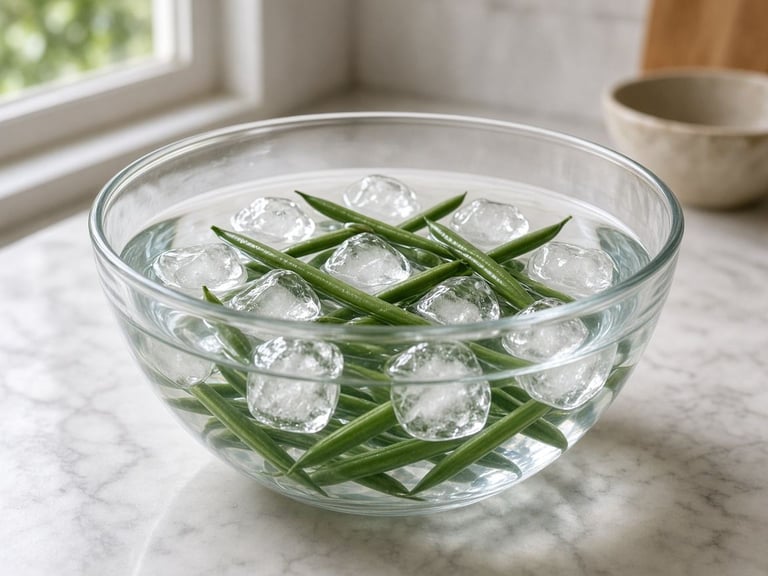
Blanching is a short boil that denatures the enzymes still working in a cut vegetable, which is what keeps frozen green beans green for months instead of gray in the bag. The ice bath has to last as long as the boil. Heat left in the pieces keeps cooking them, and once the cell walls give up, cold water cannot put them back.
The enzymes do not stop in the freezer
Cutting a vegetable mixes enzymes with the compounds they act on. In the refrigerator that reaction is slow enough that you eat the food first. At freezer temperatures it does not stop. It just runs for months, and the damage shows up as flat flavor, dull color, and a limp bite. A brief trip through boiling water denatures those enzymes, so the reaction cannot keep going after the bag is frozen. The same heat drives air out of the tissue, which is why the color looks brighter the moment the pieces come out, before any pigment has actually changed.
The National Center for Home Food Preservation treats that step as required for almost every vegetable headed to the freezer. It also knocks loose surface dirt. It is not a canning process, and it does not make a low-acid vegetable safe to keep at room temperature.
The timing is the part people get wrong. A blanch that stops short stimulates the enzymes, and the center is explicit that this is worse than skipping the step. A blanch that runs long cooks out flavor, color, and vitamins. The clock is the whole method.
Start the clock when the pot boils again
Use a gallon of water for each pound of prepared vegetables, already at a hard boil, in a pot large enough that the pieces can move. Lower them in and keep the burner high. The water has to come back to a boil within a minute. If it does not, there is too much vegetable in the pot, the pieces on the bottom sit in water that is merely hot, and that is an underblanch even when the minutes were counted honestly.
Count from the moment the boil returns, not from the moment the vegetables went in. Cover the pot so the water climbs back faster, then leave the heat high for the whole time.
Steam does the same enzyme job for a few vegetables, and it takes about one and a half times as long. Broccoli is one where either method is fine: three minutes in boiling water, or five in steam. A microwave is not a substitute. The same source reports that microwave blanching can leave enzymes active, which is the failure that shows up later as off flavors in the freezer, and it does not save any time.
Cool for as long as you cooked
The boil is only half of it. A vegetable pulled from 212°F (100°C) water is still cooking. The outside is hotter than the center, and that heat keeps moving inward. An ice bath is what stops it. Tap water goes lukewarm within a minute once a pound of hot beans hits it.
Use enough ice that the bath stays at 60°F (16°C) or below the whole time, about a pound of ice for each pound of vegetables, and leave them in for the same number of minutes they boiled. Then drain hard. Water clinging to the pieces freezes into ice and costs quality in the bag.
Gray broccoli and mushy beans are both decided before that bath does anything useful. Chlorophyll loses its magnesium and turns olive when heat and the vegetable's own acids sit together too long. Pectin, the material that keeps a raw bean rigid, breaks down on the same clock. Cold water locks in whatever state the vegetable already reached. It does not reverse either one.
Times, counted from the returning boil
These are water-blanch minutes from the National Center for Home Food Preservation. Where you steam instead, run about half again as long, except where a steam time is already given.
| Vegetable | Minutes |
|---|---|
| Asparagus, small / medium / large stalks | 2 / 3 / 4 |
| Snap, green, or wax beans | 3 |
| Broccoli florets, about 1½ inches (or 5 steamed) | 3 |
| Brussels sprouts, small / medium / large | 3 / 4 / 5 |
| Cabbage, shredded | 1½ |
| Carrots, small whole / sliced or in strips | 5 / 2 |
| Cauliflower florets, about 1 inch | 3 |
| Corn on the cob, small / medium / large ears | 7 / 9 / 11 |
| Corn kernels (blanch the ear, then cut) | 4 |
| Collards / other greens, including spinach | 3 / 2 |
| Green peas | 1½ |
| Edible pea pods | 1½–3 |
| Summer squash | 3 |
Cut one vegetable to a similar size. Thin pieces overcook while the thick ones are still raw in the middle.
A same-day blanch is a shorter job
None of that schedule applies to vegetables you are cooking tonight. A head start for a stir-fry, or a tray of beans you want to hold for an hour, only has to set the color. Pull them when the green is brightest, shock them so they do not slump on the counter, and stop. The full enzyme-killing times are for months in a freezer, not for dinner.
If those beans are going into a hot pan afterward, pat them dry first. A wet surface has to boil off before anything browns, and by then you have cooked them a second time. Salt in the blanching water seasons food you will eat today. It does not change the enzyme clock, and the freezing method does not call for it.