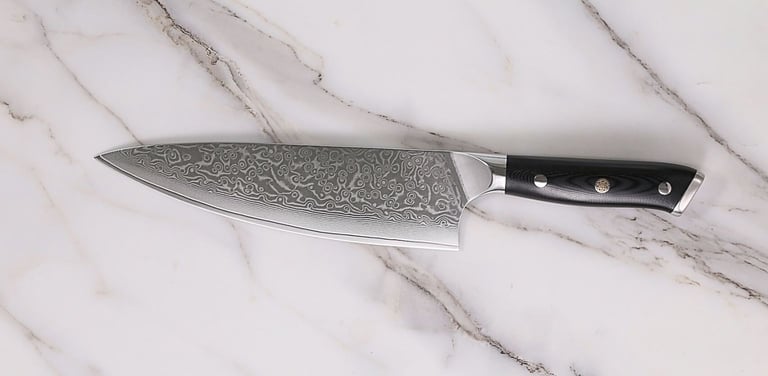
Stainless steel doesn't mean rust-proof. It means the blade grows an invisible layer of chromium oxide the instant it meets air, and that layer defends the steel underneath — right up until salt, acid, or standing water breaks it down faster than it can repair itself.
The layer doing all the work
Steel only counts as stainless once it's at least 10.5% chromium by weight. That chromium reacts with oxygen the moment the metal is exposed, forming a film only a few atoms thick across the whole surface. You can't see it and you can't feel it, but it's the only thing standing between the iron in the alloy and the air.
Scratch it and it comes back. That's the part paint and plating can't do — expose fresh chromium to oxygen and the film rebuilds itself within seconds. Rust only wins when something interrupts the rebuild faster than it can happen: a film of salt water sitting on the edge overnight, tomato acid left to dry into the grind lines, a wet blade stacked in a drawer where air barely reaches one side.
Why carbon steel gives up faster
The nearest thing to a stainless chef knife is a carbon steel one, and it rusts on a completely different clock. Carbon steel has almost no chromium, so there's no self-healing film to begin with — bare iron meets water and oxygen directly, and visible orange rust can show up within a few hours of being left wet.
Cooks who use carbon steel anyway aren't ignoring this. They're trading it for an edge that sharpens finer and holds it longer, because steel without chromium can be hardened further without turning brittle. The trade only works if you wipe the blade dry and run a thin film of oil across it after every use. The oil is doing the job the missing chromium can't.
Rust shows up at the edge first
Every sharpening pass grinds away a sliver of steel and exposes metal that hasn't built its oxide film yet. That's the first reason. The second is geometry: the edge is the thinnest cross-section on the whole knife, so the same rate of corrosion eats a visibly larger share of it than it does anywhere on the spine or the flat of the blade.
What the dishwasher actually does
A dishwasher attacks a knife two ways at once, and neither is the wash itself. Heat and a closed, humid cycle keep the blade wet for far longer than toweling it off would, and that extra time is exactly what the passive layer needs someone to deny it. Detergent adds salt to that water, and chloride is one of the fastest ways to punch a hole through chromium oxide. This is called pitting, and it doesn't heal the way a clean scratch does. Meanwhile the rack is banging the edge against forks and other blades on every cycle, rolling or chipping it while the surface corrodes.
What actually stops it
Dry the blade as soon as you're done washing it. That single habit removes the water film corrosion needs to keep working, and it matters more than what soap you use or how new the knife is. Don't let salted water, brine, or citrus sit against the edge — rinse it off instead of leaving it to dry there on its own. Store the knife dry, edge exposed to air, rather than damp in a closed sheath or stacked against other blades. If it's carbon steel, the oil film isn't optional. Treat it the way you'd treat a cast iron pan.