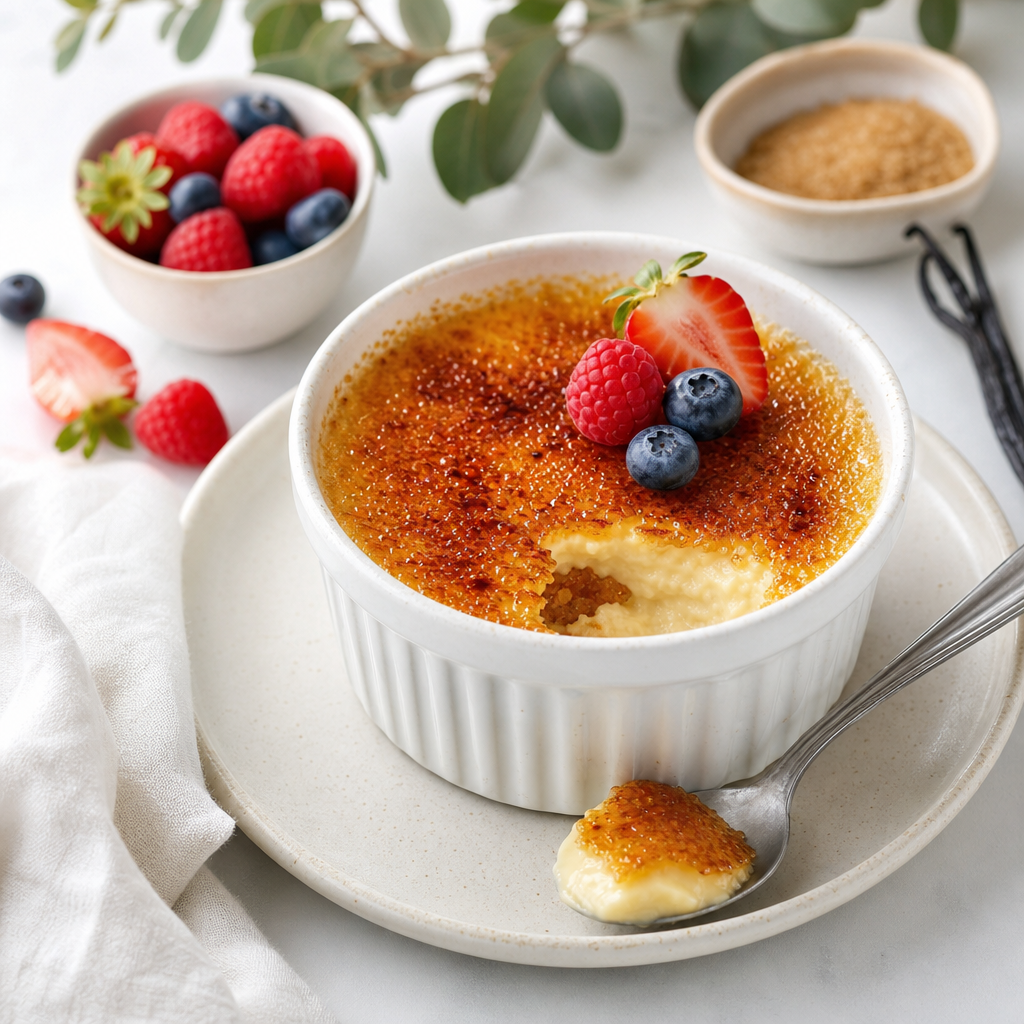
Crème Brûlée
Silky, custard-set cream yields a velvety interior that contrasts with a thin, glassy caramelized sugar crust that shatters under the first spoon. The texture is smooth and creamy, with pure vanilla flavor and a bright burnt-sugar finish.
Use whole eggs and extra egg yolks for a rich, stable custard; heavy cream gives body while a touch of vanilla keeps the flavor classic. Swap vanilla bean for high-quality extract if you prefer, and for a lighter version use a 50/50 mix of milk and cream—expect a slightly less dense texture. If you don't have a kitchen torch, the oven broiler works fine but watch closely to avoid burning.
Serve chilled for dinner parties, date nights, or holiday menus; prepare the custards a day ahead to save time and let flavors settle. Pair with fresh berries, a short cookie, or a simple espresso. Store refrigerated (un-caramelized) up to 48 hours and caramelize sugar just before serving for best crispness.
Before You Start
How to Make It
-
1
Arrange the ramekins
Place six 150–180 ml ramekins in a deep baking dish or roasting pan.
-
2
Heat the cream
Heat the heavy cream and the split and scraped vanilla bean in a saucepan over medium heat until it just begins to steam and small bubbles form at the edge; do not boil. Remove the cream from the heat and let it steep for 10 minutes. If using vanilla extract, stir it in after removing the cream from the heat.
-
3
Whisk the yolks
Whisk the egg yolks, 50 g granulated sugar, and salt in a bowl until pale and slightly thickened.
-
4
Temper the yolks
Temper the egg yolks by slowly pouring the warm cream into the yolk mixture in a thin stream while whisking constantly until combined.
-
5
Strain the custard
Strain the custard through a fine-mesh sieve into a large measuring cup or bowl to remove any cooked bits and the vanilla pod.
-
6
Fill the ramekins
Pour the strained custard into the ramekins, dividing evenly. Pour hot water into the baking dish to come halfway up the sides of the ramekins to create a water bath.
-
7
Bake the custards
Bake the custards for 30–40 minutes, or until they are mostly set but still slightly wobbly in the center when gently shaken.
-
8
Cool the custards
Carefully remove the ramekins from the water bath and cool them to room temperature, then refrigerate them uncovered for at least 2 hours and up to 48 hours.
-
9
Caramelize the sugar
When ready to serve, sprinkle about 1 teaspoon (≈8 g) of granulated sugar evenly over each chilled custard. Use a kitchen torch to melt and caramelize the sugar until it forms a thin, glassy crust. If using a broiler, place the ramekins on a foil-lined baking sheet and broil 6–10 cm (2–4 in) from the heat, watching closely and rotating as needed until the sugar melts and browns.
-
10
Harden the caramel
Let the caramelized tops sit for 1–2 minutes to harden, then serve. Store any uneaten custards refrigerated; if stored without caramelized sugar, re-sugar and torch them just before serving.
Related guides
Still hungry? Try one of these
Oven-Roasted Ratatouille with Parmesan Polenta (45-Minute Vegetable Dinner)
Oven-roasted ratatouille of eggplant, zucchini, peppers, and tomatoes served over creamy Parmesan polenta — weeknight vegetarian one-pan dinner.