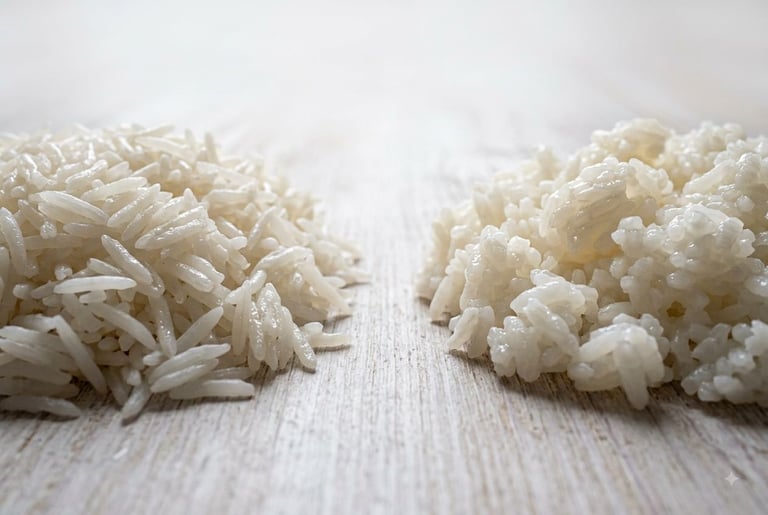
Reach for jasmine when a recipe wants basmati and the dish won't taste wrong so much as feel wrong — softer, clingier, missing the separate bite basmati is built for. Both are long-grain and aromatic, and both lean on the same fragrance compound at close to the same strength, so smell won't tell them apart reliably.
What actually splits them is starch: basmati carries close to a quarter of its weight in amylose, enough to make the grain stretch lengthwise as it cooks instead of swelling, while jasmine carries less and swells round.
Why basmati gets longer instead of wider
Cook any rice and the underlying mechanism is the same one behind every starch-thickened sauce: water pushes into the granule, the granule swells, and past a certain point it gives way. Where basmati splits off is what happens next.
The starch inside that granule comes in two shapes, and the ratio between them is what a rice variety really is. Amylose is a long, unbranched chain that lies flat against its neighbours and packs into tight, ordered regions. Amylopectin is shorter and branches constantly, so it can't pack the same way and leaves the granule looser.
Basmati's amylose runs close to a quarter of the grain's weight — high for a rice — and that tighter, more crystalline packing resists ballooning outward the way a looser granule would. The cells inside a basmati grain are also laid out end to end rather than in a loose tangle, so whatever swelling does happen gets funneled along the grain's length instead of pushing it wider.
A well-cooked basmati grain ends up close to twice as long as it went into the pot, with barely any change in width. An ordinary long grain adds maybe half its length again. Basmati roughly doubles.
Why jasmine ends up softer and stickier
Jasmine runs the opposite profile. Its amylose sits in the high teens, closer to a sixth of the grain than a quarter, which leaves amylopectin in charge. A jasmine grain expands more evenly in every direction instead of stretching lengthwise, and more starch works its way out to the surface as it cooks.
That surface starch is the glue — it coats each grain, and adjacent grains stick to each other through it, which is exactly the texture jasmine is grown for. Skip the rinse and the effect gets more obvious, the same reason a bowl of unrinsed jasmine clumps and a bowl of unrinsed basmati mostly doesn't.
The aroma is closer than people think
It's easy to assume smell is doing more of the differentiating than it actually is. Both rices owe their fragrance to the same compound, 2-acetyl-1-pyrroline, and to the same broken gene — a mutation in an enzyme called betaine aldehyde dehydrogenase that stops it from clearing out a byproduct, which then gets converted into that compound instead. Basmati and jasmine arrived at the identical mutation independently, in separate breeding lineages on separate continents, and landed on variations of the same smell rather than two different ones.
What differs is concentration and the minor volatiles riding alongside it — basmati often reads nuttier, jasmine more floral. If you're trying to tell one from the other by smell alone, don't count on it.
Does soaking basmati actually matter
For basmati, yes, enough that most recipes calling for it also call for a soak, typically twenty to thirty minutes in cold water. Soaking lets water work its way to the center of the grain before any heat is involved, so once the pot goes on, the outside and the inside gelatinize closer to together instead of the surface finishing first. That evenness is what lets the grain stretch cleanly along its length instead of splitting or turning mushy at the tips before the middle catches up.
Jasmine doesn't need the same head start. It isn't elongating in the first place, so there's less to protect by pre-hydrating it, and oversoaking mostly just primes more surface starch to gelatinize sooner — one more push toward stickier, not away from it.
Where reaching for the wrong one actually shows
The swap is loudest in a biryani. Basmati's job there is structural — long, separate grains that stack in layers with the meat and hold that shape on the plate — and jasmine's clingier grains collapse that layering into something closer to a casserole.
It's quieter in a curry eaten by the spoonful, where the rice is mostly there to carry sauce. Basmati and jasmine both do that job fine, and jasmine's stickiness is arguably an advantage there, catching more sauce per bite. Neither swap ruins dinner. They're just closer to right in different directions.