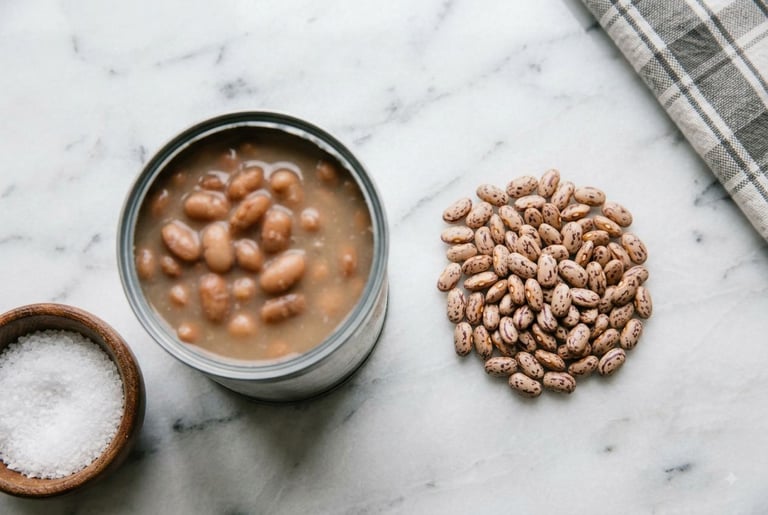
What you're buying when you reach for a can instead of a bag is somebody else's decision about doneness, salt, and time — made months ago in a factory, sealed under pressure, and impossible to undo once you pop the lid. A bag of the same beans hands all three decisions back to you, at the cost of your own time instead of theirs.
Why a canned bean tastes flatter than one you cooked yourself
Flavor gets into a bean while it's still raw and absorbing liquid, the same way it gets into rice or pasta — through a structure that's open and taking on water. A canned bean already finished that process before it reached your kitchen, so simmering it in stock and garlic for ten minutes only seasons the outside. The inside was sealed shut months ago. That's most of why a pot of beans built from dry tastes like whatever you cooked them in, and a can of beans mostly tastes like beans, plus whatever thin canning liquid clings to the surface.
Why a canned bean can never be underdone
The cannery had no say in that, and neither did you. Beans are a low-acid food, and any low-acid food sealed in a can has to reach temperatures a boiling pot of water never will. Low-acid foods are sterilized at 240°F to 250°F (116°C to 121°C) under pressure — hot enough, held long enough, to destroy Clostridium botulinum spores that plain boiling can't touch. That heat is also far more than beans need to go tender, so by the time a can is safe to sit on a shelf for two years, the beans inside are already cooked past any point you could have stopped them. There's no such thing as an al dente canned bean. The doneness was decided at the factory, in favor of safety, not texture.
What the hours actually buy you
A bean cooked from dry softens gradually — 45 minutes for a small soaked one, up to a couple of hours for chickpeas — at whatever pace you set and in whatever liquid you choose. That is the whole return on the time. You get to call it done the moment it matches what you want — firm enough to hold its shape in a salad, or soft enough to fall apart into a stew — and a can only ever offers you one answer to that.
Why the overnight soak barely costs you anything
The case against dried beans is almost always argued as labor, and that is the wrong axis. Tipping beans into a bowl of water the night before takes about a minute. The simmer after it runs unattended while you do something else in the same kitchen. Hands-on, a pot of beans from dry costs a few minutes more than opening a can.
What it actually costs is knowing tonight what you're eating tomorrow. That's a real requirement, and some evenings it isn't met. But anyone already planning a day ahead — which is most people cooking for a household — is paying almost nothing for the better-tasting pot.
What a bag does that a can can't
Two of the advantages only show up over months rather than in one dinner.
A bag keeps for years. A shelf holding black beans, pintos, chickpeas and lentils covers a dozen dishes without a shopping trip, and it doesn't have to be restocked in the specific quantities a recipe demanded. Cans get bought against a plan and run out against a different one.
And dried beans portion. A dish wanting a cup and a half of beans gets a cup and a half — no open tin in the fridge slowly becoming a decision. Sodium works the same way: cooking from raw means you set it, rather than working around whatever the can already committed to.
The real price gap is in cooked weight, not the price tag
A pound of dried beans, cooked, comes out to roughly two and a half to three times its dry weight — enough to fill four or five drained cans' worth of cooked beans, from something that costs a fraction of what four or five cans do. That ratio is the number that actually matters, not the sticker price on either package, because a can and a bag aren't selling you the same quantity of finished food.
Which one to reach for
Reach for a can when you didn't plan, and don't feel bad about it. It's two minutes from cupboard to pot, and in something carrying enough tomato, chile and stock to season a bean from the outside — a fast chili, an enchilada filling — most of what a dried bean offers ends up buried under the sauce anyway. The same goes for anything puréed or cooked to collapse. Hummus from a can of chickpeas is perfectly good hummus.
Cook from dry when the bean is what you're going to taste: a plain pot as a side, a salad where bite matters, or the broth itself, which a can cannot give you at any price. That, and when you'd rather shop four times a year than four times a month.