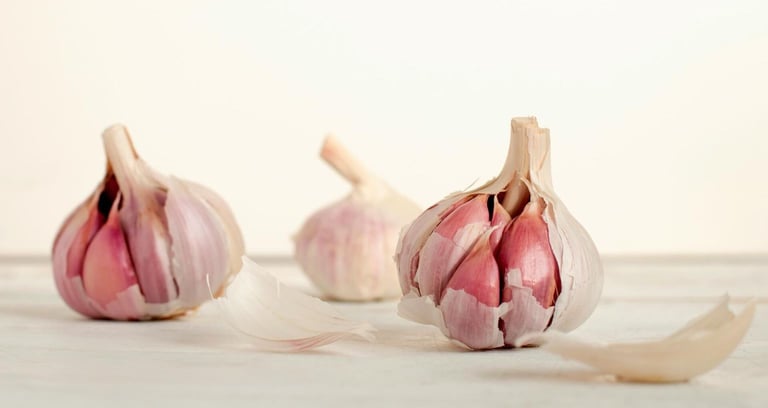
An intact head of garlic keeps for three to five months in a dry cupboard, and the single worst place to put it is the refrigerator. That is not a matter of degree. A head stored at 40°F (4°C) will sprout sooner than the same head left on the counter, because cold is the signal that starts the clock rather than the thing that stops it.
Everything below follows from one fact: a head of garlic is not an ingredient sitting in storage. It is a living plant that is dormant, and storing it well means keeping it that way.
Why the fridge is the wrong place
A garlic bulb overwinters underground and sprouts when the cold breaks. It measures that transition by accumulating time spent cool and damp — the same mechanism that tells tulip bulbs when to come up. Somewhere around 40–50°F (4–10°C), with humidity, a clove reads the conditions as a passed winter and begins to germinate.
A refrigerator holds almost exactly those conditions. So does a sealed bag, which traps the moisture the bulb gives off and hands it back.
A cupboard at 60–65°F (15–18°C) is above the range that triggers germination and below the range that accelerates drying out, which is the only reason it works. It is not that cupboards are gentle. It is that they are outside the window.
| Form | Where | Roughly |
|---|---|---|
| Whole head, intact | Cupboard, dry and dark | 3–5 months |
| Loose cloves, unpeeled | Cupboard | 10 days |
| Peeled cloves | Fridge, airtight | 1 week |
| Chopped or minced | Fridge, airtight | 2 days |
| Chopped | Freezer, pressed flat | 3 months |
Why chopped garlic can't be stored
Raw garlic has almost no smell until you cut it. An intact clove holds two things in separate compartments: alliin, which is odorless, and an enzyme called alliinase. Rupturing the cell walls mixes them, and within about ten seconds they react to form allicin — the compound responsible for everything people mean by "garlicky."
Allicin is also unstable. It begins breaking down into milder sulfur compounds within hours, which is why garlic chopped in the morning smells flat by evening and harsh by the next day. Refrigeration slows this without stopping it.
This is the real reason the storage times collapse the way they do. You are not watching garlic spoil. You are watching a chemical reaction that has already fired run to completion, and there is nothing to be done about it except not to start it early.
It also explains a smaller thing: crushed garlic tastes sharper than sliced, and sliced sharper than whole, because each cut ruptures more cells and produces more allicin. Cooking denatures alliinase, so a clove dropped whole into a braise never makes much allicin at all — which is why long-cooked garlic goes sweet rather than pungent.
The one genuine safety line
Garlic stored in oil at room temperature is one of the few real botulism risks in a home kitchen, and the reason is specific rather than general caution. Clostridium botulinum spores live in soil, garlic grows in soil, and the spores survive on the cloves. Oil excludes oxygen. Garlic is low in acid. Warm, airless, and low-acid is precisely the combination the bacterium needs to leave dormancy and produce toxin, and the toxin has no smell or taste.
Refrigeration slows it enough that homemade garlic oil is fine for a few days. Commercial jarred garlic is acidified below pH 4.6, which is why it tastes faintly sour and why it is shelf-stable when yours is not.
When to throw it out
Soft or spongy under the skin, brown patches, or a fermented smell — those are done. A green shoot is not. Sprouting means the bulb has read its conditions as spring and started spending itself, so it will taste harsher and keep getting worse, but it is food. Halve the clove, lift the shoot out, and use it in something robust.