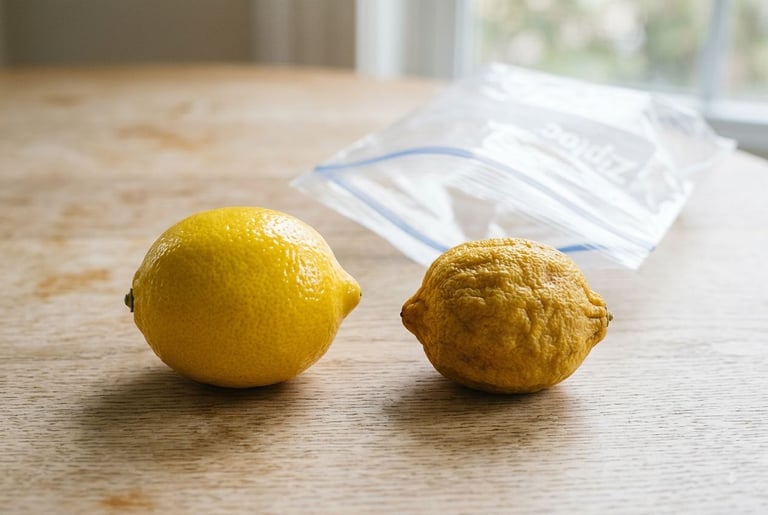
A lemon that looks half-dead on the counter — wrinkled, light for its size — isn't spoiled so much as thirsty. It has been losing water through its own peel since the day it was picked, and sealing it in a bag in the refrigerator does not stop that process. It only slows it down, from about a week to about a month.
Why lemons shrivel instead of rotting
Lemons are non-climacteric, which means they stop ripening the moment they're picked. Nothing about them improves in storage. What changes from there is purely water leaving the fruit, through the waxy layer that coats the peel and through the cut where the stem used to be.
That layer slows evaporation. It doesn't stop it. A lemon at room temperature keeps losing moisture at a steady rate until the rind, which has some give when fresh, collapses onto a shrinking interior and turns wrinkled. The flesh inside follows the same path — less juice, a thicker layer of dry pith, a fruit that feels lighter than it looks.
Heat is what drives this. Warmer air pulls water out of the peel faster, the same way a warm room dries laundry faster than a cold one.
Why cold slows the same problem it prevents
Refrigeration works on this in two directions at once, which is easy to miss if you think of "keeping it fresh" as one thing. Cold slows the rate of evaporation, for the same reason a warm room speeds it up. And cold slows mold growth, because fungal spores need warmth to germinate and spread.
A lemon in the fridge is losing water more slowly and is less hospitable to the organisms that would otherwise ruin it. Neither effect depends on the other. You get both from the same shelf.
Why the bag matters as much as the fridge
An open shelf in a refrigerator is not a sealed environment. Most home fridges actively pull moisture out of the air to keep frost from building up, which means unwrapped produce sitting on a shelf is still drying out — just more slowly than it would on the counter.
A sealed bag or container breaks that cycle. It traps a small pocket of humid air right against the peel, so there's nowhere for the lemon's moisture to go. That's the whole trick. It isn't refrigeration alone that buys you weeks instead of days — it's refrigeration plus an enclosure that stops the air from constantly resetting to dry.
One caution: don't seal a wet lemon. Water left standing against the peel invites the mold that cold is supposed to be holding off.
How long each method actually buys you
| Storage | Roughly how long it stays good | What you notice |
|---|---|---|
| Countertop, out in the open | about a week | rind softens and wrinkles, juice yield drops |
| Fridge, loose on a shelf | around two weeks | shriveling is slower but still visible by week two |
| Fridge, sealed bag or container | three to four weeks | rind stays taut, juice loss is barely noticeable |
| Freezer, juice or zest only | three to four months | whole fruit turns mushy on thaw — fine once you're squeezing or grating |
Dried out is not the same as spoiled
A wrinkled lemon is still a working lemon. It will give up less juice and more of that juice will need to be squeezed past thickened pith, but nothing about the fruit has become unsafe. Zest it, juice it, or trim the rind and use what's underneath — the flavor is a little duller, not dangerous.
Actual spoilage looks different: a soft spot that's wet rather than dry, a patch of blue-green fuzz, or a smell that's gone sour instead of bright. That fuzz is almost always a Penicillium mold, the same genus responsible for the classic green rot on citrus, and it doesn't stay where you can see it. Its filaments spread through the moisture-rich flesh well past the visible spot, so cutting around it doesn't make the rest of the fruit safe to eat. If you see that, the whole lemon goes.