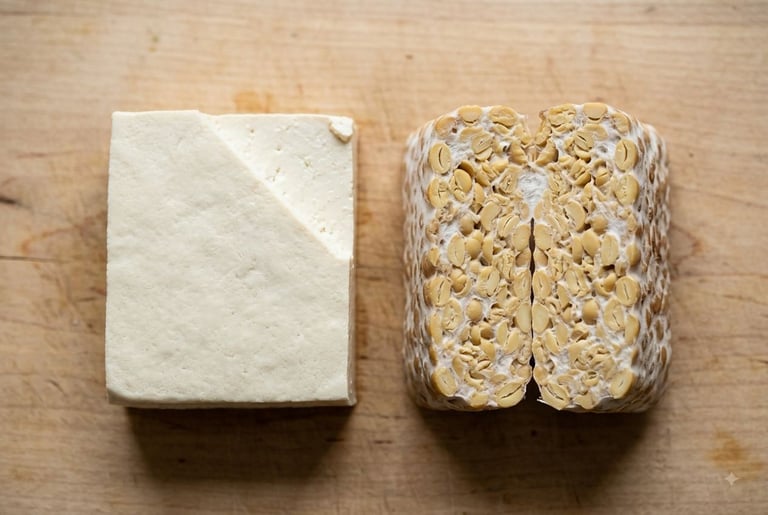
A block of tofu started as soy milk, curdled with a coagulant and pressed the way cheese is pressed — the bean itself never makes it into the finished block. A block of tempeh started as whole soybeans, cooked and bound into a cake by a living mold that's often still active when you buy it. One is a curd. The other is the bean itself, intact, holding itself together. That's the whole difference, and it's why a thin slice of tofu falls apart under a spatula and a thin slice of tempeh doesn't.
How soy milk becomes a curd
Making tofu starts by soaking, grinding, and boiling soybeans, then straining the slurry through cloth. What's caught in the cloth — the fiber, the hull fragments, most of what gives a raw soybean its beany smell — becomes okara, a byproduct that never goes into the tofu at all. What passes through is soy milk: water, dissolved protein, and fat, with almost nothing solid left in it.
A coagulant stirred into that hot milk — calcium sulfate, nigari, or a food acid, depending on the maker — makes the dissolved protein clump into curds, the same basic move rennet makes on dairy milk. Those curds get pressed in a mold, squeezing out the whey and leaving a block that is still about 70 percent water when it is firm, and nearly 87 percent when it is left silken and never pressed at all. Almost nothing that carries flavor survives that process, which is why plain tofu tastes like so little on its own. Most of it left with the okara.
What the mold is actually doing to the beans
Tempeh skips the straining step. Soybeans are cooked, split, and dehulled, then inoculated with spores of Rhizopus oligosporus and left somewhere warm, around 85 to 90°F (29 to 32°C), for a day or two. The mold's mycelium — a network of fine white threads — grows through the gaps between the beans and knits the whole mass into a single dense cake. Nothing is removed. The bean's fiber, its fat, its shape: all of it is still there, just bound together by fungus instead of a coagulant.
While it grows, the mold also feeds on the beans, and its enzymes break down some of the protein into free amino acids and some of the fat into free fatty acids before the tempeh ever reaches a pan. That predigestion is where the flavor comes from — not the bean on its own, but what the mold already did to it, which reads as nutty, faintly mushroomy, and more assertive than tofu's blank slate.
The black spots are the mold aging, not spoiling
Rhizopus mycelium is white while it's actively growing, and most tempeh looks that way fresh out of the package. Given a few more days, even in the fridge, that same mold starts to sporulate, and its spores are black. Grey or black patches — usually clustered around the perforations where the packaging let in the most air — mean the culture kept maturing, not that it failed. Tempeh with black spots and a clean, nutty, mushroom smell is still good to cook.
What actually means spoiled looks different in kind, not just in shade. Pink, orange, or yellow patches mean a different organism has taken hold, one that isn't Rhizopus and has no business being there. A slimy surface or a sharp ammonia smell means the same thing regardless of color. Any of those, and the block goes in the trash no matter how normal the mold looks elsewhere on it.
Why tofu gets pressed and tempeh gets steamed
Tofu's problem is water. A block straight from the package is mostly liquid held loosely in the curd, and that water is what stops a marinade from getting in and stops a cut face from browning in a hot pan. Pressing it under weight for about ten minutes forces enough of that water out that the surface can actually crisp and the inside has room to take on something else.
Tempeh doesn't have that problem — there's very little free water in a cake of whole cooked beans to begin with, so pressing it accomplishes nothing. A short steam or simmer does something different: it softens the dense bean structure and takes the edge off a faint bitterness some batches carry from fermentation, while opening the surface enough that a marinade soaks in instead of beading on top. Tofu is holding too much liquid. Tempeh is too tightly built for liquid to get into. Different obstacle, different fix.