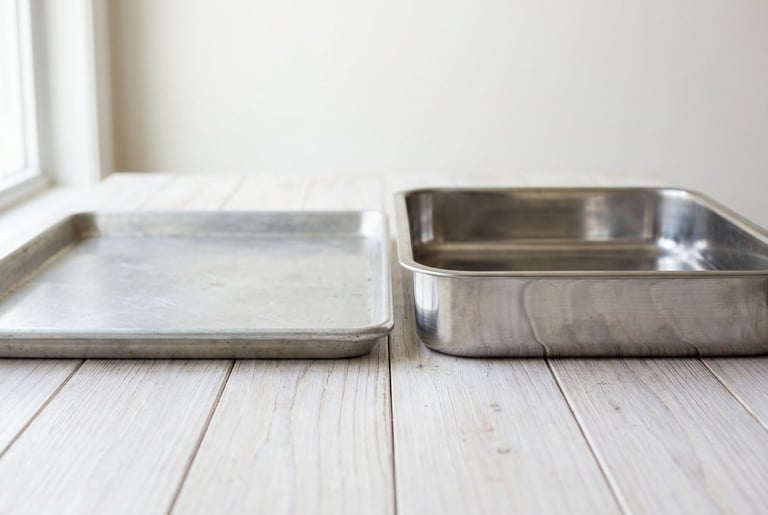
The difference is wall height, not size or price. A sheet pan's rim runs about half an inch, low enough that the steam thrown off by roasting food escapes into the oven as fast as it forms. A roasting pan's walls run two to three inches, high enough to hold that same steam directly over the food instead of letting it go. One pan lets the surface dry out and brown. The other keeps it damp and closer to simmering than roasting.
Why low walls brown and high walls steam
Browning needs a dry surface above roughly 300°F (150°C) — that's the Maillard reaction, and it can't get started while there's still liquid water sitting on the food, because that water holds the surface near its own boiling point until it's gone. On a sheet pan, steam has nowhere to collect. It rises off the food and mixes straight into the oven's air, so the surface dries within a few minutes and starts to color.
A roasting pan's tall sides change that math. Steam rising off a chicken or a tray of root vegetables hits the wall of hot, humid air trapped inside the pan and has to fight its way out past the rim. Some of it condenses and drips back down. The surface underneath stays wetter, longer, and browning gets delayed by however long that takes to clear — often past the point where the food is already cooked through.
A crowded sheet pan fails the same way
Wall height is the main lever, but it isn't the only one. Pile vegetables onto a sheet pan two layers deep and the pieces in the middle are surrounded by other wet surfaces on every side, so the steam they throw off has nowhere to go but sideways into the next piece. The rim never gets involved — the crowding alone recreates the humid pocket a roasting pan's walls would have made on purpose. Give each piece a little open pan around it and the low rim does its job.
Why a turkey wants the pan a vegetable doesn't
A whole turkey sheds far more liquid than most food that goes in an oven — rendered fat, released juice, sometimes a cup of stock added for basting — and all of it needs somewhere to sit besides the oven floor. A roasting pan's depth is built for that volume, and the rack most of them come with lifts the bird clear of the drippings so the skin isn't sitting in liquid while it's supposed to be drying out and crisping.
That's the opposite of what broccoli needs. There's no pooling liquid to contain, so the tall walls only add a humid pocket the vegetable didn't have a reason to sit in. The same pan that's right for a turkey is the wrong shape for almost everything else that goes in an oven.
Gauge and color aren't just about speed
A thin, dark sheet pan heats up fast because dark metal absorbs more radiant energy, and thin metal has less mass to bring up to temperature. That's usually an advantage — faster browning, a shorter cook — but it also means the edges of the pan, which get the most direct exposure, can scorch before the center of a tray is even done. Heavier pans, and lighter-colored ones, absorb heat more slowly and spread it more evenly, which is closer to what most roasting pans are built like. The tradeoff runs the other way too: even heat is calmer to work with, but it browns more slowly and needs a longer cook or a hotter oven to catch up.
When a sheet pan already does the job
Most of what a home cook roasts — vegetables, chicken pieces, sausages, a spatchcocked bird — browns better with the steam allowed to leave, which makes a sheet pan the better default rather than the smaller substitute. A roasting pan only pulls ahead when there's real drippings volume to contain and a rack to lift the food above it. Outside of a holiday turkey or a large roast, most kitchens could get by without one.