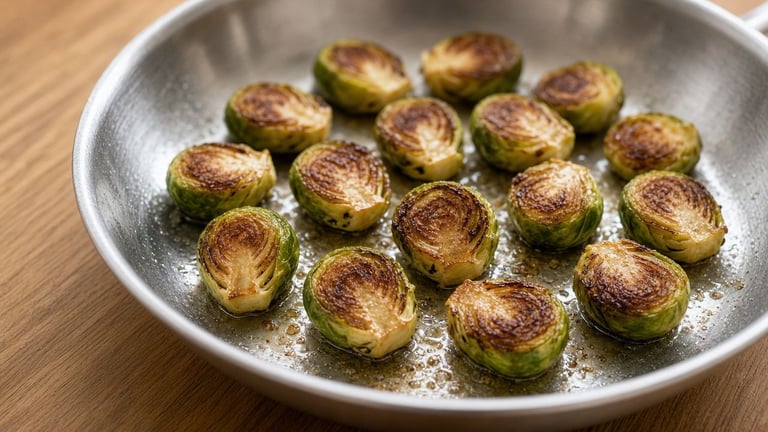
A bitter batch is usually savable, a mushy one mostly is not, and a sulfurous one sits in between. If the sprouts came out of the oven pale and bitter, put them back in a very hot pan and brown them. Browning plus a little sweetness and acid covers most of what you taste. Boiled-soft sprouts have lost the structure that made them sprouts, so the best you can do is change what they are.
Salvage, by what went wrong
Bitter but firm. Halve any whole ones. Get a wide skillet properly hot over medium-high heat with a tablespoon or two of oil or butter, then lay the sprouts in cut-side down in one layer and leave them alone for 3 to 4 minutes. You want a dark brown face, not a pale one. Finish off the heat with a teaspoon of maple syrup or honey and a splash of vinegar or lemon, then a pinch of salt. Taste before adding more of any of them.
Sulfurous. The smell comes from compounds already released, so there is less to work with. Browning in a hot pan does help, because it builds new roasted flavors on top, and acid brightens what is left. Serve them right away, uncovered. Held in a covered dish, they keep generating it.
Mushy. Boiling past about ten minutes breaks down the pectin that held the leaves together. You cannot rebuild it. Shred or chop the sprouts, squeeze or pat them dry, and fry in a hot oiled skillet for about 5 minutes until the edges catch. They become hash, not roasted sprouts. Soup is the other honest option.
Burnt. Pick off any leaf that has gone black, because that bitterness is char and nothing hides it. Brown, deeply colored leaves are fine and taste sweet.
Where the bitterness comes from
Sprouts are in the cabbage family, and they carry glucosinolates, sulfur-containing compounds that taste bitter and sharp. When a cell is cut or chewed, an enzyme called myrosinase meets them and converts them into more pungent compounds. That is the raw-cabbage bite. Cooking changes the picture in two directions. Heat shuts the enzyme off, and heat in water lets some of those compounds dissolve and wash away. Neither is a fix by itself.
What a pale, undercooked sprout still has is plain bitterness with nothing sweet or savory to stand against it. Browning supplies that. It is the Maillard reaction, and it builds roasted, nutty flavors from the sprout's own sugars and amino acids. Bitterness does not disappear, it gets crowded. Sweetness, fat, and a little acid push it back, and salt turns bitterness down on its own. This is also why sprouts roasted to dark edges taste sweeter than boiled ones, even with nothing added. The same logic runs through what makes roasted vegetables taste sweet.
Where the sulfur smell comes from
Boil sprouts for a long time and the sulfur compounds break down further into smaller volatile ones, the kind your nose catches across the kitchen. That is the cabbage-water smell. A covered pot holds the same compounds in with the sprouts, and a covered serving dish does it again at the table. Speed and open air are the two ways to stay ahead of it.
Mush runs on a separate clock. Vegetables soften because heat dissolves pectin, and a sprout boiled for ten minutes has none left to hold its leaves together. The water is part of the problem too: boiling submerges the sprouts, so they take on water and lose flavor to the pot, where steaming would not.
Why a crowded pan makes it worse
Browning needs a dry surface above about 300°F (150°C). Wet sprouts on a crowded pan do not get there. They release steam, the steam has nowhere to go, and the pan becomes a lid. You end up steaming them in their own water. That produces soft, pale, bitter-sulfur sprouts, the exact failure above, in the oven rather than the pot. Cold food in a hot pan loses temperature fast, and a pan crowded with sprouts has no way to win it back.
What to do next time
- Cut and place. Trim the stem and halve lengthwise, leaving loose leaves on. Set them cut-side down. Large sprouts can be quartered so everything is about the same size.
- Dry them. Rinse ahead of time and dry them fully. Wet sprouts steam.
- Heat. Roast at 425°F (220°C) on a preheated sheet pan, for 20 to 25 minutes, tossing once halfway. A skillet works too: medium-high, cut-side down, 4 to 6 minutes before you stir.
- Space. One layer, with gaps. If they touch on every side, use two pans.
- Fat. About 1 tablespoon of oil per pound (450 g). Too little and the cut faces scorch rather than brown.
- Finish. A sweet-and-sour glaze at the end, such as maple with balsamic, or cider with Dijon mustard, takes the last edge off. Add it in the final few minutes, since sugar burns before sprouts finish.
- If you boil, keep it short. Blanching for a few minutes, then drying, is a legitimate head start, but long boiling is how mush and sulfur happen.