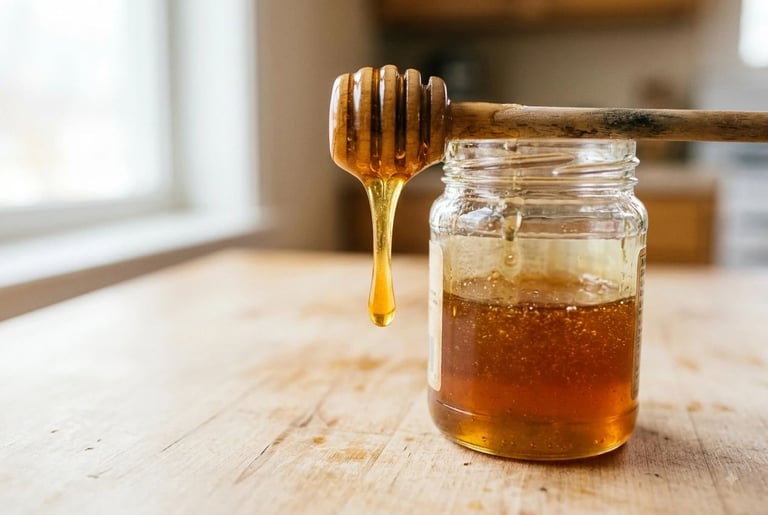
Honey doesn't spoil under normal storage, and archaeologists have pulled jars of it out of Egyptian tombs still edible after three thousand years. That's not a fluke or a marketing line. Honey's chemistry makes it one of the few foods that genuinely resists time, and the changes people mistake for spoilage — cloudiness, hardening, a darker color — are something else entirely.
Why microbes can't grow in honey
Bacteria and yeast need available water to function, not just sugar and warmth. Honey holds so much dissolved sugar that almost none of its water is actually free — food scientists call this low water activity, and honey sits around 0.6, well under the 0.75 to 0.91 that most bacteria and mold need to get started at all. Drop a microbial cell into honey and osmotic pressure pulls water out of it faster than the cell can replace it. It doesn't get sick. It dehydrates and dies.
That's the whole mechanism. No preservative, no processing. Just sugar concentrated enough to starve anything trying to live in it.
One exception matters. Honey can carry dormant spores of Clostridium botulinum, the bacterium behind botulism. They survive in honey because they aren't trying to grow there — they're waiting for conditions an adult gut never provides. An infant's digestive system is different enough that it can. Never give honey to a baby under 12 months old; past that age, it isn't a risk.
Why it turns hard and cloudy anyway
Honey is a supersaturated solution. It holds more dissolved glucose than water can normally keep in solution at room temperature, which is an unstable state by definition. Over time the excess glucose falls out, forming crystals that scatter light and eventually turn the whole jar solid. This has nothing to do with spoilage. It's the same chemistry as sugar recrystallizing in an old jar of jam.
Temperature decides how fast it happens. Crystallization runs fastest around 50°F to 59°F (10–15°C) — cooler than most kitchens, but close to what a refrigerator runs at. That's why chilling honey backfires: it pushes the jar toward the temperature band where crystals form quickest, instead of slowing them down. Above roughly 70°F (21°C), glucose stays dissolved and honey stays liquid for much longer.
How to store it so it stays liquid longer
Keep the jar sealed and at normal room temperature, in a cabinet away from the stove. Honey is hygroscopic — it pulls moisture out of the air given the chance — and enough absorbed water can eventually let wild yeast already present in the honey start fermenting it. A loose lid left open over a year does more damage than any amount of ordinary warmth.
That fermentation is the one genuine way honey goes off. It's rare, since commercial honey is processed down to a moisture content low enough that it essentially can't happen. But if a jar ever smells sour or boozy, or fizzes when you open it, that's fermentation, not crystallization, and it belongs in the trash.
Fixing honey that's already crystallized
Warm it and the glucose redissolves, the same reaction running in reverse. Set the jar in a bowl of hot tap water, not boiling, for ten or fifteen minutes, stirring once partway through. That's usually enough for honey that's gone cloudy. Fully solid honey takes longer, sometimes a second change of hot water.
Stay under about 140°F (60°C). Push honey hotter than that and its sugars start breaking down into hydroxymethylfurfural, a compound that darkens honey and leaves it tasting flatter and faintly caramelized. Nothing dangerous happens — it's a flavor loss, not a safety issue — but a microwave makes it easy to blow past that line in seconds without noticing. That's the real argument for the water bath over the microwave.