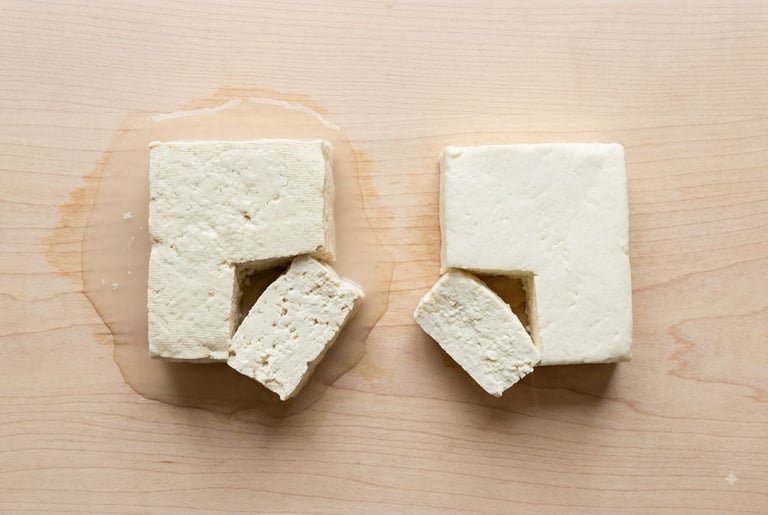
Swap tofu for paneer in a curry and the dish still comes together, which is exactly why people treat the two as interchangeable. They aren't built the same way. Paneer curdles in seconds, when acid hits milk close to a boil. Tofu sets more slowly, when a mineral salt like nigari or calcium sulfate reorganizes the proteins in soy milk instead. That one difference — acid against salt — decides how much water ends up trapped in each curd, and it's the reason one of them needs pressing before it goes near a hot pan and the other doesn't.
Why neither one melts
Both curds are held together by cross-links that heat doesn't undo. In paneer, acid dropped into milk close to a boil locks the casein proteins into a tight mesh almost instantly — there's no gentle unwinding involved, just an abrupt coagulation that squeezes out whey as it happens. In tofu, the coagulant supplies magnesium or calcium ions that bridge soy proteins into a similar locked gel, just built more gradually and at a lower temperature. A rennet-set aged cheese like mozzarella melts because its protein network is loose enough for fat to flow through once warmed. Neither paneer nor tofu has that kind of network. More heat just tightens what's already set and drives out a bit more water, which is why both hold their cube shape through a long simmer instead of dissolving into the sauce.
Why tofu needs pressing and paneer doesn't
Tofu's gel forms gently enough that it holds onto a lot of the whey inside its own structure — that's why it's sold sitting in a tub of water, and why every tofu recipe on this site opens with the same instruction: wrap it, weight it down, and give it ten minutes before it goes anywhere near a pan. Skip that step and the surface stays wet enough to steam instead of brown, and any cornstarch coating slides right off. Paneer starts from a different place. The acid that sets it pulls the whey out almost the instant it hits the hot milk, so the curd is already dense by the time it's drained and pressed into a block during production. There's little water left to force out at home, which is why a recipe like paneer butter masala goes straight from the cutting board to the pan.
What that means for a marinade or a sauce
Because paneer's curd is closed and dense from the moment it forms, a marinade or a spooned-over sauce mostly stays on the surface no matter how long it sits — the flavor comes from what's browned onto the outside, not from anything that soaked in. Pressing does the opposite for tofu: it clears out enough of the trapped water that the cubes pick up noticeably more of a marinade or pan sauce in the same few minutes, especially once frying has opened up the surface further.
Not the vegetarian swap it looks like
Treating tofu and paneer as one substitution skips over the fact that they don't share a starting ingredient at all. Paneer is milk, curdled and pressed, and nothing else. Tofu is a soy product with no dairy anywhere in it. Both are vegetarian; only tofu is vegan. When a recipe calls for one by name instead of the other, that's usually the actual reason.