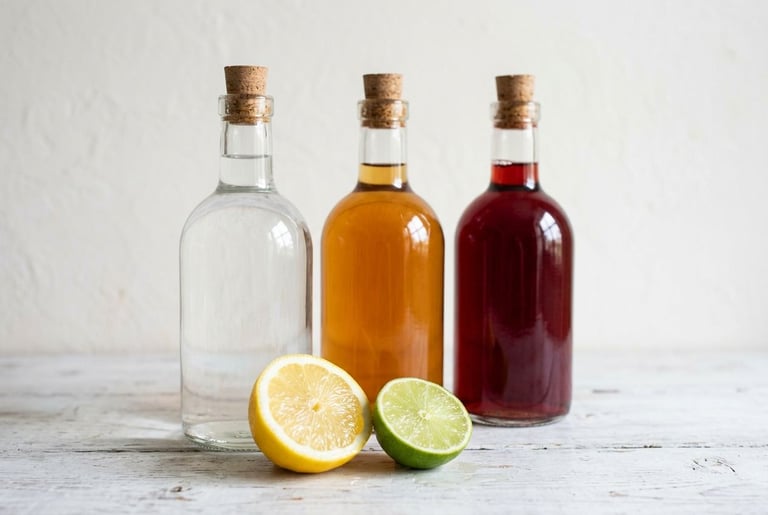
pH is a count of loose hydrogen ions in a liquid, and nearly everything acid does to food comes down to what those ions land on. Drop the pH of raw fish and its proteins unfold as if a pan had heated them, no flame involved. Drop the pH of blanched green beans by two points and their color slides from bright green to a tired olive. Same ion, different target, different result.
Why acid "cooks" fish without any heat
A protein holds its folded shape partly through electrostatic bonds between charged spots along its chain — a kind of internal scaffolding. Raw fish sits close to neutral pH, where that scaffolding stays put and the flesh stays translucent. Soak it in lime juice at pH 2 and the flood of hydrogen ions neutralizes those charges one by one. The bonds let go, the protein strands unfold and tangle into a new arrangement, and the flesh turns from translucent to opaque — the same visual change heat produces, reached by a completely different route.
That's texture, not sterilization. Acid never gets near the temperature that kills bacteria or parasites, so fish "cooked" this way carries the same raw-fish risks as sashimi. US health codes require fish destined for raw or acid-marinated service to be frozen first — seven days at -4°F (-20°C) is one of three accepted methods — because the lime juice in the bowl was never doing that job.
Why lemon juice keeps cut apples and avocado from browning
The enzyme responsible for browning cut fruit, polyphenol oxidase, is a protein too, and it's just as sensitive to pH as the fish above. It runs fastest in the mildly acidic range a fresh-cut apple or avocado naturally sits in, oxidizing exposed compounds into the brown pigments you're trying to avoid. Brush the cut surface with lemon or lime juice and the local pH drops low enough to distort the enzyme's own folded shape — an enzyme that's lost its shape can't catalyze anything. The vitamin C in citrus juice adds a second effect on top of that, chemically reducing brown pigments back to something closer to colorless, but the pH drop alone would slow browning even without it.
Why green vegetables turn drab when acid hits them
Chlorophyll owes its color to a magnesium ion sitting at the center of the molecule, held there by four nitrogen atoms. Hydrogen ions compete for that same spot, and given enough of them, they shoulder the magnesium out and take its place. What's left is called pheophytin, and it's a dull olive-brown instead of green. A splash of wine, a squeeze of lemon, or the vegetable's own organic acids concentrating during a long simmer under a lid all supply enough hydrogen ions to make that swap. Cooking green vegetables uncovered lets those acids escape with the steam instead of building up in the pot, which is the real reason a quick, uncovered blanch holds color and a long simmer in sauce doesn't.
Why pickle brine keeps vegetables crisp
A vegetable's crunch depends on pectin, the substance cementing neighboring cell walls together. Pectin breaks down through a reaction called beta-elimination, and that reaction runs slower as pH drops and faster as it climbs. A vinegar brine sitting at pH 2 to 3 leaves pectin largely alone, which is why a pickled cucumber or onion keeps its bite for weeks. Push pH the other way — a pinch of baking soda stirred into a pot of dried beans — and the same reaction runs fast enough to soften them well ahead of schedule, and turn them to mush if you overdo it.
Why some canned foods need a pressure canner and others don't
Acidity decides more than crunch. Clostridium botulinum, the bacterium behind botulism, can't grow or produce its toxin below pH 4.6, and a properly made pickle brine sits well under that line. Most vegetables without added acid — green beans, corn, anything that isn't fruit or pickled — sit above it. That's why a jar of pickles processes safely in a pot of boiling water while a jar of plain green beans needs a pressure canner to get there safely.