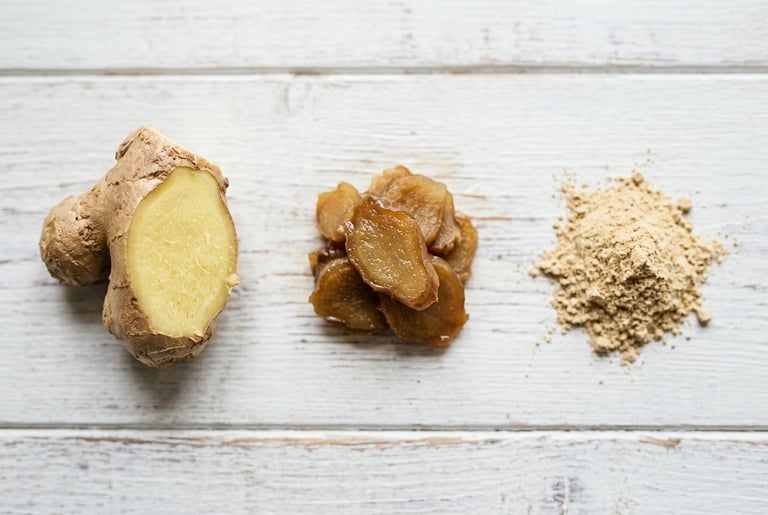
Raw ginger, cooked ginger, and ground ginger taste like three different ingredients because they mostly are. The compound responsible for ginger's characteristic bite, gingerol, is unstable, and it converts into two different molecules depending on what happens to the root. Heat turns it into something sweeter. Drying turns it into something sharper. Neither one is just a weaker or stronger version of fresh.
Why cooked ginger tastes milder
Raw ginger's pungency comes from gingerol, a compound that sits in the rhizome's tissue and hits the tongue with a sharp, almost citrusy heat. Heat breaks gingerol apart in a reaction that removes part of its structure, and what's left behind is zingerone — a compound with a rounder, spicier-sweet flavor and roughly a tenth of gingerol's bite. This is why ginger simmered into a broth or sautéed into a stir-fry tastes warm and mellow rather than sharp, even at a quantity that would be aggressive raw.
The conversion needs sustained heat, not just a hot pan for a minute. A quick sear barely touches it. A curry that simmers for twenty minutes converts a good share of the gingerol in it, which is part of why long-cooked ginger dishes taste rounder than a quick stir-fry made with the same amount of root.
Why dried ginger tastes sharper, not weaker
Drying pushes gingerol the other direction. Removing water from the tissue causes gingerol to lose a molecule of water and rearrange into shogaol, a compound that food chemists rate as noticeably more pungent than the gingerol it came from. That's the opposite of what most dried herbs and spices do — drying usually mutes flavor as volatile aromatics evaporate, but ginger's heat compound gets more aggressive, not less.
This is why ground ginger can't stand in for fresh in a recipe where the fresh flavor was the point. It isn't a weaker echo of the fresh root. It's a different compound with a harsher, hotter profile and none of the citrusy top notes gingerol carries, which is also why a cookie or gingerbread recipe built around ground ginger tastes wrong made with fresh instead — the whole flavor it was designed around isn't there.
Why fresh ginger won't let gelatin set
Fresh ginger carries a second compound that has nothing to do with flavor: zingibain, a protease enzyme that cuts apart protein chains. It's the same category of enzyme as the bromelain in fresh pineapple and papain in papaya, and it does the same job — chopping long protein strands into pieces too short to do what they were doing.
Gelatin sets by letting long collagen-derived protein chains tangle into a mesh that traps liquid. Zingibain cuts those chains before they can tangle, so a gelatin dessert made with raw ginger juice stays a puddle no matter how cold it gets. Cooking the ginger first solves it, because heat unfolds the enzyme's structure and stops it from cutting anything. That's also the mechanism behind using grated raw ginger in a meat marinade — the same enzyme is loosening muscle protein, which is why ginger in a marinade tenderizes and ginger added at the end of cooking doesn't.
Why grating matters more than chopping
Ginger rhizome is built from long fibers running the length of the root, the same structural fibers that carry water and nutrients while it's growing. A knife cutting straight down the root slices along those fibers instead of through them, which is why chopped ginger so often leaves stringy threads in a finished dish. Grating across the grain on a microplane shreds the fibers short, turning the root into a fine pulp instead of leaving long strands behind, and it opens up far more surface area for the juice inside the cells to escape.