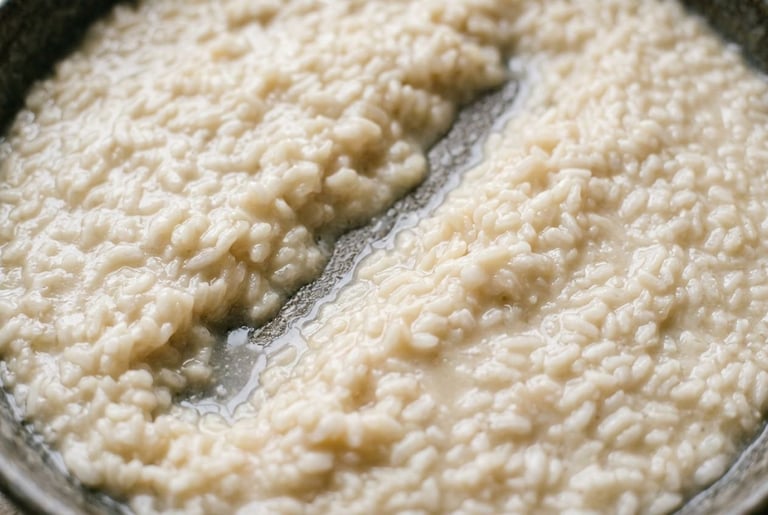
A pot of risotto is really just short-grain rice and hot stock, fed to each other slowly enough that the rice has time to give something back to the liquid — the starch that makes the whole thing creamy without a drop of cream.
The rice, the ratio, and why long-grain won't work
Risotto needs a short-grain rice bred for exactly this job. Arborio and carnaroli are the two you'll actually find, and both are high in amylopectin, a branched starch that dissolves easily into liquid. Long-grain rice like basmati or jasmine leans the other way, high in amylose, which is why it stays separate and fluffy instead of releasing much of anything. Swap one in for the other and there's nothing for the stirring to work with — you'll get sticky, undercooked grains rather than a creamy sauce.
Work from a ratio rather than a fixed recipe: about 1 cup of dry rice to 4 cups of hot stock, which comes out to roughly three generous bowls as a main course, or five or six smaller ones as a starter. Scale the rice up or down and scale the stock with it — the method underneath doesn't change.
The soffritto, and toasting the rice before any liquid touches it
Start with a soffritto — onion, finely diced, sweated in butter or olive oil until soft and translucent with no color on it. Add the dry rice straight into that fat and stir for a minute or two, until the edges of the grains turn glassy and the raw, chalky smell turns nutty. That step coats each grain in fat before any liquid touches it, which is part of what keeps the core of the grain intact even as the outside goes soft later on.
Wine first, then stock — and why the stock has to be hot
Deglaze the toasted rice with a splash of dry white wine, about half a cup per cup of rice, and let it cook off completely before adding any stock. You should stop smelling raw alcohol and start smelling something closer to vinegar. From there the stock goes in hot, half a cup or so at a time, kept at a bare simmer in a separate pot the whole time you're cooking.
Cold stock does more than slow things down. Dropping cold liquid into a simmering pot pulls the temperature down hard enough to stall the cooking, and the rice sits in tepid liquid until the pot recovers. Do that eight or ten times over the course of a risotto and the total cooking time stretches well past what the rice actually needed, with the outside of each grain spending far longer in the pot than the center does.
Stirring, and how you'll know it's working
Stir often while each ladleful cooks in, not nonstop, but enough that the grains keep rubbing against each other and against the pot. That friction is the actual mechanism: it wears the starchy outer layer off the rice and into the stock, thickening the liquid around the grains into a loose, glossy sauce instead of leaving you with rice simmered in broth.
You'll feel the pot change before a clock tells you anything useful. A spoon dragged across the bottom leaves a slow wave that closes back over itself in a second or two, rather than snapping shut instantly or sitting open. Taste a grain around the 18-minute mark. The outside should have no bite left, and the center should give with only the faintest firm core, not a hard, floury one.
Finishing off the heat
Pull the pot off the heat a shade before the rice is exactly where you want it — it keeps cooking gently in its own residual heat for another minute. Beat in a knob of cold butter and a handful of grated parmesan off the heat, stirring hard enough to bring the fat and the starchy liquid together into an actual emulsion rather than just melting the butter on top. Let it sit, covered, for a minute before serving. That's when the loose wave you were watching for in the pot settles into what ends up on the plate.