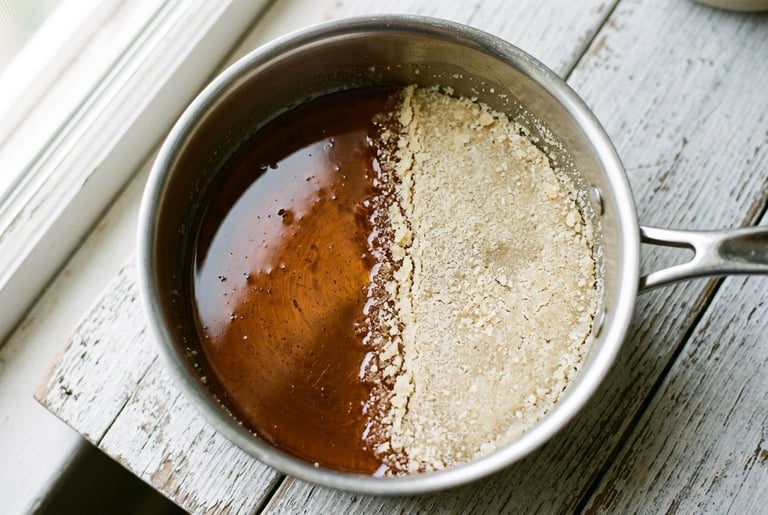
Sugar dissolved in water would rather be a crystal than a liquid, and boiling it only postpones the argument. Cook a sugar syrup past the point where water can hold that much sugar in solution and it turns supersaturated — unstable, waiting for an excuse. Give it one: an undissolved grain, a smear of dried syrup on the side of the pot, the tip of a spoon dragged across the bottom. The whole pan can go from clear liquid to a gritty, seized mass in the time it takes to notice.
What caramel actually is
Caramel starts as one ingredient — sugar, cooked until heat breaks part of it down into deeper color and flavor. What it becomes after that depends on what gets added and how far the cook goes. Cooled thin on a slab, it snaps into a hard candy shell. Loosened with cream and butter while still hot, it turns into a pourable sauce or a fudge base. Poured into a mold before it fully sets, it's the bitter-sweet lining under a flan.
There are two ways to get sugar there. Dry caramel melts sugar alone in a bare pan — fast, but every crystal has to melt on its own, so a pan with any hot spots scorches in patches before the rest has even started to color. Wet caramel dissolves the sugar in water first, roughly one part water to four parts sugar by volume, just enough to turn it into wet sand. The water has to boil off before real caramelizing begins, and by the time it does, every grain is already in solution instead of sitting in a dry pile waiting its turn.
Why one crystal takes the whole pot with it
That dissolving step is also what sets up the crystallization risk. A crystal doesn't form and stop — its surface becomes the easiest place for dissolved sugar molecules to fall out of solution and lock on, so the process feeds itself, one crystal breeding the next, until syrup that was pourable a moment ago is a solid, sandy mass. Stirring after the syrup starts boiling is often what starts it, by knocking a crystal off the side of the pan into the liquid. Washing down the sides with a wet pastry brush, rather than a spoon, keeps that seed from ever forming.
A small amount of acid or corn syrup works differently, and earlier. Lemon juice or cream of tartar splits some of the sucrose into glucose and fructose; corn syrup brings in glucose molecules that were never sucrose to begin with. Either way, the syrup ends up full of differently shaped sugar molecules that don't stack into an orderly lattice the way pure sucrose does, so there's less for a stray crystal to organize. A teaspoon per cup of sugar is enough — much more, and there's too little sucrose left for the caramel to set firm once it cools.
Why the color moves fast near the end
While the syrup still holds a lot of water, added heat mostly goes into boiling that water away, so the pan can sit near 212°F (100°C) looking almost unchanged for a while. Once most of the water is gone, there's very little liquid left to absorb the stove's heat, and the temperature climbs fast. That's exactly when the color starts moving: pale straw around 320°F (160°C), full amber by 340°F (171°C), a deep mahogany by 350–360°F (177–182°C). From clear syrup to burnt can happen in under a minute once it starts climbing, right at the point where it looks like nothing is happening.
Why cold cream added to hot caramel erupts
Caramel headed for a sauce sits at 340–350°F (171–177°C) when the cream goes in, and cream straight from the fridge is close to freezing by comparison — and mostly water. Water dropped into sugar that far above its own boiling point doesn't warm up gradually; it flashes to steam almost instantly, and that sudden expansion is what throws hot sugar out of the pan rather than just making it bubble. Pulling the pan off the heat first, warming the cream before it goes in, and pouring it in a slow stream while whisking all narrow that gap enough to keep the reaction calm instead of violent.