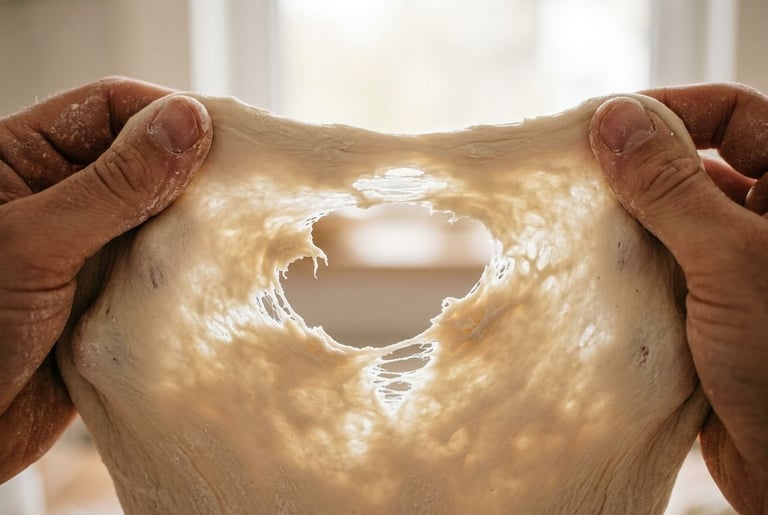
Almost all of it. Reball the dough, let it rest for ten to fifteen minutes, and shape it again — a torn or slack skin from a first attempt rarely survives into the second. The one exception is dough that's already overproofed, because by then its gluten has no stretch left to spend on a new shape, no matter how careful the second attempt is.
Shaping builds tension against the counter — it doesn't mold dough into shape
A shaped loaf holds its form because its outer layer is stretched tauter than its interior, not because you pushed it into a ball. Dragging the underside of the dough against a mostly bare counter creates just enough friction that it catches slightly with each pass, and that catch pulls the surface layer smooth and tight while the interior mass folds inward beneath it. Flour kills that catch. A dough dusted heavily enough to glide freely under your hands never builds any tension at all.
Why dough tears instead of tightening
Two different problems produce the same tear. Overproofed dough has already spent its gluten's elastic capacity holding gas during bulk fermentation, so there's nothing left to stretch when you ask the surface to tighten — pull on it and it gives way at its weakest point instead of smoothing out. Dough shaped straight after dividing tears for the opposite reason: the gluten hasn't had time to relax the stress that kneading and folding put into it, so it's still tangled rather than aligned, and pulling it taut rips the tangle apart instead of drawing it smooth. A short bench rest fixes the second problem completely. It does nothing for the first.
Why dough sticks instead of releasing
Warm, wet dough is naturally tacky, and a little tack is what shaping depends on — it's the difference between a slight catch that builds tension and a hand that comes away with half the surface stuck to it. Too little flour, or dough that's climbed above roughly 75°F (24°C), tips past that line. Dust the counter and your hands just enough that contact stops feeling wet, not enough that it feels dry. Work fast, too: dough that releases cleanly at the start of shaping can turn tacky again two minutes later once it's warmed from your hands.
Why dough slumps instead of holding its shape
A shaped dough that spreads flat instead of sitting up has a skin too slack to hold its own weight against gravity. Too much bench flour is the most common cause, because it removes the friction that builds tension in the first place. Underdeveloped gluten does the same thing from the inside — dough that wasn't kneaded or folded enough during bulk fermentation doesn't have a network strong enough to tighten even when the friction is right. The fix isn't more flour on the outside. It's more structure, built earlier, or a shape that doesn't demand much structure to begin with — a batard instead of a boule, or a loaf pan that holds the sides up for you.
The seam matters as much as the skin
Every shaped loaf has a seam where the dough was pinched or rolled closed underneath, and that seam only holds if bare dough is touching bare dough. Flour on the surface at that point works the way flour on a rolling pin does — it stops things from sticking, which is exactly what you don't want there. A seam dusted with flour before it's sealed reopens in the oven, and the loaf spreads sideways through the gap instead of rising up through the score on top.
None of this is a food-safety question — a torn or slumped loaf bakes exactly as safely as a perfect one. The real cost of reshaping is time: a dough that's reballed and rested has spent bulk fermentation minutes it won't get back, so give it a shorter final proof after a reshape than the recipe calls for, or it can overproof before it ever reaches the oven.