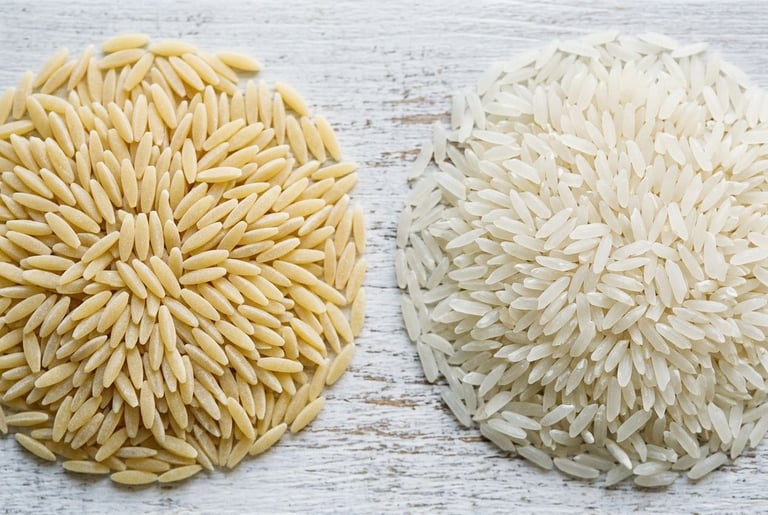
Put orzo and rice in the same pot with the same measured amount of broth, and only one of them drinks the liquid dry. Orzo is durum wheat pasta, built with gluten, and it sheds starch into whatever it cooks in rather than sealing water inside itself the way an intact rice grain does. That one fact is where every practical difference between them comes from.
Why a cup of broth disappears into rice, but not into orzo
A grain of milled rice is a closed structure — the bran and germ are gone, but the starchy endosperm underneath is still one intact unit. Cook it in a measured amount of liquid and the grain swells as its starch gelatinizes in place, pulling most of that liquid inside itself.
Get the ratio right, cover the pot, and by the time the rice is done there's little to nothing left standing in the bottom. That's why a fixed cup-of-rice-to-cups-of-water formula works at all: the grain is doing the absorbing, not the pot.
Orzo has no such structure to absorb into. It's durum wheat semolina, mixed with water and pressed into a rice-like shape, and what holds it together is gluten — the network of glutenin and gliadin that forms wherever wheat flour gets wet. That network doesn't seal starch inside a sealed unit the way a rice grain's outer layers do. It cooks the way any pasta cooks: starch bleeds continuously off the surface into the surrounding liquid for as long as it's in the pot.
Rinsing rice, never rinsing orzo
Rice recipes on this site almost always start the same way: rinse under cold water until it runs clear. That step has nothing to do with the starch locked inside the grain — it's washing off starch dust abraded loose during milling and packaging, dust that would otherwise dissolve straight into the cooking liquid and glue grains together before the real cooking even starts.
Nobody rinses orzo first, because there's nothing sitting loose on the surface to remove. The starch that ends up in an orzo dish's liquid got there during cooking, not before it, and it's frequently the point — it's the same starch bleed that turns a pot of pasta water cloudy and lets a splash of it thicken a sauce.
Orzo can be boiled and drained. Rice on this site never is
Orzo behaves like any short pasta: boil it in a big pot of water, drain it, and use it in a salad or toss it with sauce, no different from macaroni. It can also be cooked the other way, absorption-style, the way one of this site's own recipes handles it — orzo goes into hot oil to coat, then broth gets added and the whole thing simmers, closer to how risotto is built than how rice is built.
Rice, by contrast, almost never gets boiled in excess water and drained here. Every rice-based recipe on this site cooks it in a measured, mostly-absorbed amount of liquid, covered, then rested off the heat. Orzo has both options open to it. Rice, as this site uses it, really only has the one.
Salt the orzo water like pasta water, not like rice water
Because so much of orzo's cooking liquid gets thrown away or cooked down to almost nothing, the water needs to be salted heavily up front — closer to how you'd season a pot for spaghetti than how you'd season rice's cooking liquid. Orzo only has a few minutes of contact with that water before most of it disappears down the drain or into a sauce, so a light hand barely reaches the inside of each piece.
Rice can't take that same salt level. Since nearly all the liquid ends up absorbed rather than poured off, whatever salt goes into the pot stays in the finished dish. A ratio that tastes right for pasta water turns a pot of rice inedibly salty, because none of it had anywhere to drain away to.
Where orzo actually stands in for rice
Orzo works as a rice substitute in soups, cold salads, and any dish where the grain is meant to sit suspended in a sauce or broth rather than stand on its own — its chewier, more elastic bite reads as a texture choice there, not a flaw. It also works simmered risotto-style, stirred with broth added gradually, the way this site's own mushroom and spinach orzo is built.
It falls apart as a substitute anywhere a recipe wants dry, separate grains that hold their shape without attention — a stuffing mixed in after the grain is already cooked, a bowl of rice meant to rest covered and stay fluffy on its own. Leave orzo unstirred under a lid the way you'd leave rice, and the starch it keeps shedding has nowhere to go but into its neighbors.