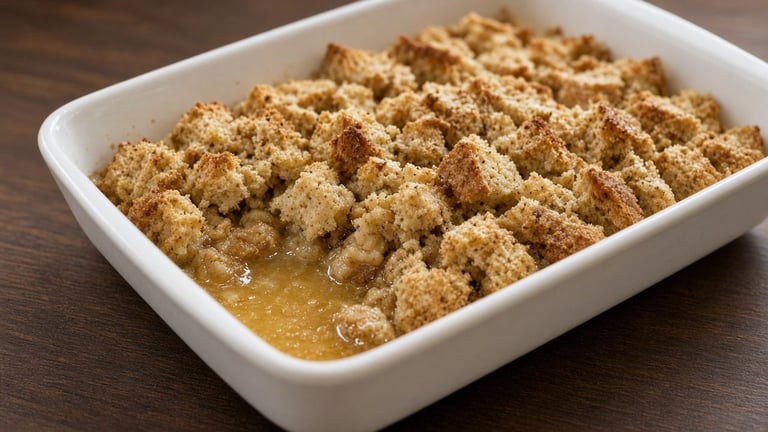
Dry stuffing is usually fixable. Drizzle warm stock over it, toss, cover the pan with foil, and put it back in the oven until it steams. Soggy stuffing is sometimes fixable: spread it out, bake it uncovered, and accept that it will end up closer to bread pudding than to the fluffy version. Don't keep adding bread to a wet batch. That fixes the texture and kills the seasoning.
What stuffing is for
Stuffing is dried bread soaked just enough to turn tender, then baked until the top browns. It sits beside the turkey as a side, soaking up gravy and giving the plate something with crunch. Some cooks bake it in a pan, some pack it into the bird. The word dressing gets used for the pan version.
Why it goes dry or wet
Dried bread is a sponge with a fixed capacity. Each cube takes up liquid until it is full, and what it can't hold sits in the bottom of the bowl or the pan. Too little stock and the crumb stays dusty and bakes into croutons. Too much and the cubes collapse into porridge.
Egg adds a second job. In the oven it sets into a loose custard around the bread, which is what holds a scoop together. Skip it and the stuffing is looser and drier. Overdo it and the middle turns eggy and dense.
The pan matters as much as the mix. Under foil, steam can't escape, so the stuffing cooks through gently and stays moist. Uncovered, the top dries and browns while the center lags behind. That is why this site's sausage, apple, and sage stuffing runs 25 minutes covered, then 15 to 20 minutes uncovered at 375°F (190°C). Covering first and uncovering last gets you both a hot, damp middle and a crisp lid.
Drying the bread matters too. Cubes baked until dry and lightly golden, about 10 to 12 minutes, can absorb far more stock than fresh bread, which is already full of its own water and goes to mush.
Saving a dry batch
Warm some stock. Cold stock soaks in slowly and unevenly. For a 9-by-13-inch pan, drizzle about 1/2 cup warm stock over the top, then toss gently with a fork so the dry cubes at the bottom and edges get some. Cover tightly with foil and bake at 350°F (175°C) for 15 to 20 minutes, until steam rises when you lift a corner. Uncover for the last 5 to 10 minutes if you want the top crisp again.
Add stock in small amounts. A dry stuffing can be rescued in two rounds. One big pour just makes a wet patch in the middle of a dry pan.
If the stuffing is already on the table, spoon warm stock directly onto individual portions, or lean on gravy. That is a patch, not a repair, but nobody at the table will mind.
Saving a soggy batch
Wet stuffing can't be dried back to fluffy, but it can be rescued. Spread it in a thin layer on a rimmed sheet pan or in a wide, shallow dish and bake uncovered at 400°F (200°C) for 15 to 25 minutes, stirring once, until the surface looks dry and the edges crisp. A thin layer matters: depth is what traps steam and keeps the middle wet.
Don't add more dried bread to a pan that already holds the right amount of seasoning. You will dilute the salt, the sage, and the sausage. If you must, add toasted bread in small handfuls and taste as you go.
Dry in the middle, crunchy on top
This is two mistakes on top of each other. The liquid was not tossed through evenly, so the cubes at the bottom of the bowl or the center of the pan stayed dry. And the foil came off too early, so the top browned before the center had a chance to steam.
Fold the stock through the bread in stages, tossing between each pour, and bake covered for the first half. If the top is browning too fast anyway, tent it with foil for the rest of the bake.
Cooking it inside the bird
A turkey is not an oven for stuffing. The packed center of a stuffed bird is the slowest part to heat, so the stuffing has to reach 165°F (74°C) in the middle, and by the time it does, the breast meat is often well past done. Raw poultry juices soak into the bread on the way, which is the food-safety half of the problem. The texture half is that stuffing inside a bird steams and never crisps, so it comes out heavy and wet. The USDA recommends baking it separately in a casserole for both reasons; if you do stuff the bird, pack it loosely and check the center of the stuffing, not just the meat.
The simple fix is a pan. If you like the flavor of the drippings, ladle a little onto the pan version before it bakes. The roulade method is a different thing: the turkey breast roulade with chestnut and cranberry stuffing uses stuffing as a filling, rolled inside the meat, and it works because the roast is thin and the temperature is monitored. The two methods are not interchangeable.
What to change next time
- Dry the bread in the oven until it feels like a crouton, not just stale.
- Start from about 2 cups of stock and an egg for 10 cups of bread, then add a splash more only if cubes look dusty. Sausage, onion, celery, and apple all give up moisture as they bake.
- Warm the stock and whisk the egg into it before you pour, so the liquid spreads evenly.
- Toss until no dry cubes show, then stop. Overmixing breaks the cubes.
- Bake covered first, uncovered last.
- Rest it for 10 minutes before serving, so the custard finishes setting.