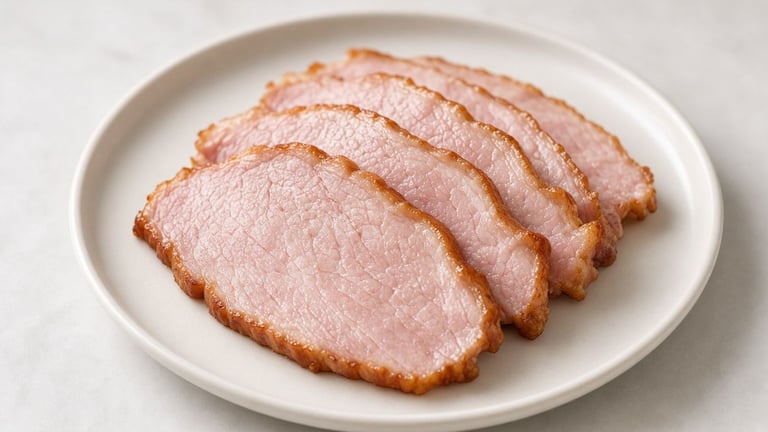
You can make a salty ham taste better, but you cannot make it less salty. The salt went into the muscle at the factory, long before the oven, and cooked meat does not give it back. What works is dilution: thin slices, unsalted food around them, and a glaze that stops adding more. A dry ham is the same kind of rescue. Moisture goes around the meat, not into it.
Why a supermarket ham starts out salty
A spiral or city ham is a cured ham. The cure is a salt brine, usually with nitrite, injected into the muscle or soaked into it, and the finished ham carries somewhere around 2 to 3 percent salt by weight. A dry-brined roast, by comparison, is aiming for half to one percent. A ham is not seasoned meat. It is meat that has been cured, and the salt is both the flavor and the preservative. That is why it tastes like ham and not like pork roast, and also why it is easy to tip past pleasant. If your problem is salt you applied yourself to a raw roast, that is a different page, on dry-brined meat that comes out too salty.
Two things push a ham further. A glaze reduced in a pan concentrates whatever salt is in it, and many glaze packets are mostly salt and sugar. And a thick slice of a salty ham has no unsalted food to share a bite with.
Can a salty ham be saved
Partly. There are four moves, and none of them is dramatic.
- Slice thin. A thin slice carries less salt per bite and takes more of the plate's other food with it. Country ham especially is meant to be cut almost see-through.
- Put it against unsalted food. Plain mashed potatoes, rolls and butter, unsalted green beans, rice, biscuits, scrambled eggs. Taste the sides before you season them. A ham dinner is the one time to under-salt everything else.
- Warm sliced ham in a liquid you throw away. Salt moves from a salty piece of meat into surrounding water until the two levels approach each other. Lay slices in a baking dish with about half a cup of water, apple juice or unsalted stock, cover with foil, and warm in a 325°F (165°C) oven until the ham reaches 140°F (60°C), around 10 to 15 minutes. Pour the liquid off. It takes out some salt and some flavor along with it. It will not turn a very salty ham into a mild one, and you should not make gravy from that liquid.
- Move it into something with a lot of dilution. Chopped into scalloped potatoes, a pot of beans, a quiche or a plain pasta with cream. The other ingredients take the salt share.
Skip the folk fixes. A raw potato in the pan does not selectively soak up salt, and rinsing a cooked ham under the faucet washes the glaze off and leaves the inside as salty as it was.
Should you soak a ham before baking
It depends on which ham it is.
| Ham | Cure | Soak before cooking? |
|---|---|---|
| Spiral or city ham | Wet-cured, fully cooked | No |
| Bone-in half ham, "fully cooked" | Wet-cured | No |
| Country ham | Dry-cured, aged for months | Yes, 4 to 12 hours in cold water in the fridge, changed a few times |
A city ham is made to be warmed. Soaking it pulls out only a little salt and a good deal of the flavor, and it makes the texture watery. A country ham is a different animal. It is a salt-heavy, long-aged, dry-cured leg, and the traditional soak plus a slow simmer or low bake is how it becomes edible by design. A country ham that tastes brutally salty after a long soak is not necessarily a mistake. It is closer to prosciutto than to a holiday ham, and it belongs thinly sliced in a biscuit.
Why a baked ham comes out dry
A supermarket ham is already cooked. The oven does not have to cook it, only warm it to 140°F (60°C). Anything beyond that is pure moisture loss. The muscle squeezes out water as it heats, and in a cured, cooked ham there is little connective tissue left to hold that water on the second trip through heat. A spiral ham makes it worse. Every slice has two cut faces open to the oven air, and the thin spaces between them heat and dry faster than the middle of the joint.
The dry edges are the first thing you notice and the part most easily fixed. Dry spiral slices can be warmed in the same covered dish as above, with apple juice, orange juice or stock instead of water, and then served with the pan liquid spooned over. Here the liquid is welcome, so use unsalted stock rather than salted, or it adds back what you were trying to dilute.
Glaze that turns out too salty
The glaze is the one salt source you control. If you have already brushed it on and the crust tastes harsh, scrape the worst of it off the slices and serve the rest thinly. Next time, thin the glaze with orange juice, cider or pineapple juice and add brown sugar or honey, rather than reducing it hard. Glaze goes on in the last 20 to 30 minutes at a higher oven, not for the full bake, so sugar browns and does not burn. If the packet is the salty part, skip the packet.
What to change next time
- Match the soak to the ham. None for a city or spiral ham. For a country ham, 4 to 12 hours in cold water in the fridge, changing the water every few hours. The saltier the ham, the longer end.
- Bake it low and covered. A 325°F (165°C) oven with a tight foil tent, cut side down for a spiral ham, in a pan with a little liquid. Plan roughly 10 to 15 minutes per pound.
- Pull it at 140°F (60°C). It is already cooked. That is the USDA reheating temperature for a cooked ham packaged in an inspected plant; one repackaged elsewhere, like a deli-counter ham, goes to 165°F (74°C). Use a thermometer in the thickest part away from the bone, since carryover will add a few degrees.
- Make the glaze, not the ham, the salty-sweet part. Taste it before it goes on, and keep it thin.
- Plan the plate. Serve it with unsalted sides and you won't need to rescue anything.