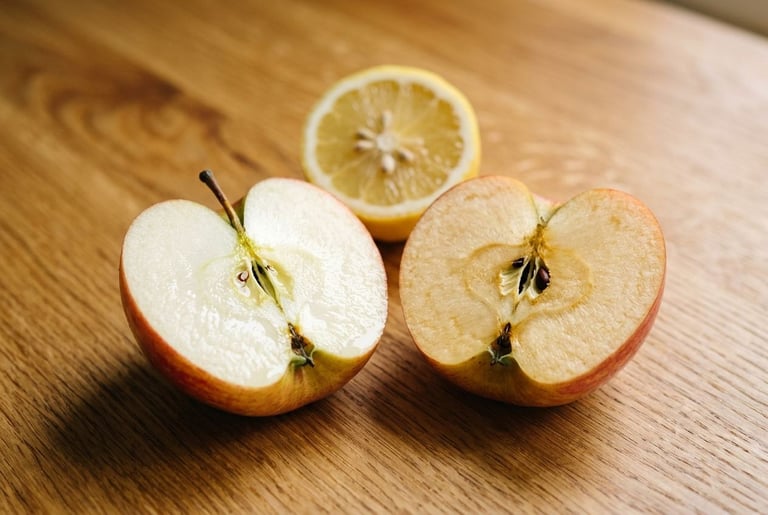
A sliced apple browns because an enzyme called polyphenol oxidase, sealed away from oxygen a minute earlier, is suddenly touching it — and it uses that oxygen to turn phenolic compounds in the apple's flesh into the brown pigment spreading across the cut surface. No heat is involved anywhere in that sentence. That's the detail worth holding onto: this is a different reaction from caramelizing sugar or browning meat in a hot pan, and it starts the instant a cell wall breaks, whether the kitchen is cold or not.
Why cutting is what starts the reaction
Inside an intact plant cell, the enzyme and the compounds it reacts with are kept apart on purpose. The enzyme sits in one compartment, the phenolic compounds accumulate in another, and neither one meets oxygen from the air, because the skin and the cell walls underneath it seal both out. Slice through an apple, peel a potato, or bruise a lettuce leaf hard enough to rupture its cells, and that separation collapses all at once. Enzyme, substrate, and oxygen end up in the same place for the first time, and the reaction that produces brown pigment finally has everything it needs to run.
What it produces first isn't brown. The enzyme oxidizes the phenolic compounds into reactive, colorless molecules called quinones, and those quinones only stay colorless for a couple of minutes before they start linking together into longer chains — the polymer that actually reads as brown, or black, given enough time. That lag is why a freshly cut apple still looks fine after thirty seconds and is unmistakably brown by the tenth minute. You're watching the chains grow, not the reaction begin.
Why some cuts brown faster than others
A peeled potato left on the counter turns pink, then gray, then brown over the better part of an hour — slower than an apple, but running on the identical chemistry, which is why recipes hold peeled potatoes in a bowl of water rather than leaving them exposed to air. Water does the same job cutting off a limb does to a wound: it keeps oxygen away from the cut surface, and the reaction can't proceed without it.
An avocado browns faster than either one. It carries a large supply of both the enzyme and its substrate packed into soft flesh with a lot of surface area, so a single scoop of the pit end can visibly darken in under ten minutes. A banana runs the same reaction, and it speeds up as the fruit ripens — riper flesh has more of the phenolic compounds on hand, which is also part of why a bruise on a ripe banana turns dark so much faster than the same bruise on a green one. Lettuce browns at its cut ribs for the same reason bagged salad greens develop rust-colored spots along the edges: the blade that sliced it did the same thing a paring knife does to an apple, just at industrial scale.
Four ways to stop it, and why each one works
The enzyme needs three things at the same moment — oxygen, its substrate, and a working pH — so every method that slows browning is taking one of them away.
| What you do | Why it works |
|---|---|
| Submerge in water, or press plastic wrap flush against the cut surface | Blocks the oxygen the enzyme needs; without it, the reaction has nothing to run on |
| Blanch it, or cook it through | Heat unfolds the enzyme's structure the same way it unfolds any protein, permanently — an unfolded enzyme can't catalyze anything again, even after the food cools |
| Keep it cold | Slows the reaction rate without stopping it, which buys time rather than solving the problem |
| Add acid — lemon juice, vinegar, a splash of pineapple juice | Pushes the pH out of the enzyme's working range, and in citrus specifically, the vitamin C also chemically converts the brown pigment back before it can fully form |
Rinsing salt or sugar off a cut fruit does nothing here — this reaction was never about either of those. Only removing oxygen, disabling the enzyme, slowing the whole process down, or changing the chemistry around it will do anything.