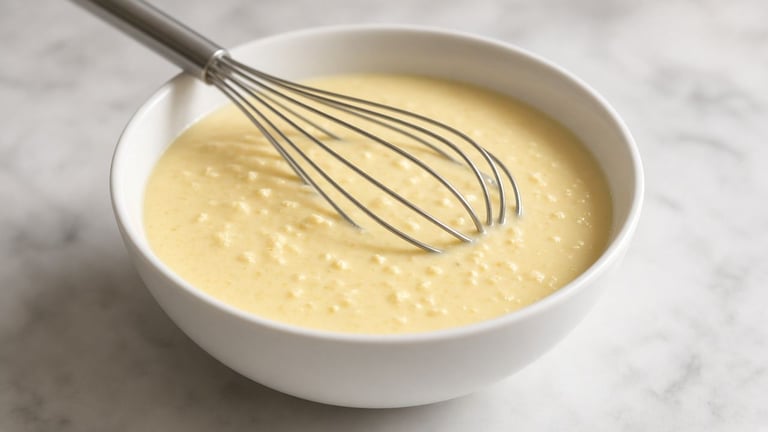
Whether a curdled batch is rescuable depends on how far the eggs went. If the eggnog looks grainy, like fine sand or tiny flecks, a blender and a strainer will usually bring it back to smooth. If it has firm, rubbery lumps and tastes like omelette, the proteins have set too hard to undo, and the honest move is to start over with the yolks you have left or a carton of the store-bought stuff.
Test before you decide
Pour a ladleful through a fine-mesh strainer. Whatever passes through is your eggnog. Look at what stays behind.
- Soft specks and a little grit: salvageable. Go to the blender steps below.
- Distinct curds that hold their shape when pressed with a spoon: partly salvageable. Blend and strain, and expect to lose some body, since the lumps you strain out took egg with them.
- Rubbery strands, or a sulfurous omelette smell: not salvageable. Blending only makes smaller pieces of overcooked egg, and the flavor stays.
What went wrong underneath
Cooked eggnog is a custard that has not set. Yolk proteins start out folded up. Heat unfolds them, and once they begin to unfold they bond to each other, building a mesh that thickens the milk and cream. In a base this dilute, that thickening shows up around 160°F (71°C), which is where you want to stop. The same bonding keeps going if you keep heating. By roughly 175–180°F (79–82°C) the mesh has pulled tight enough to squeeze out liquid and turn into curds. Every stirred custard lives in the same window; a pastry cream survives a boil only because its starch gets between the egg proteins. Eggnog has no starch, so it has no cushion. The margin between thick and scrambled is a handful of degrees.
Three things push a batch over the edge.
Too much heat, too fast. The bottom of the pan runs hotter than the middle. Yolks sitting against that surface set while the rest of the pot is still thin. Medium-low heat and a spatula that scrapes the whole floor of the pan keep the temperature even.
Yolks hitting hot milk. Pour simmering dairy straight onto raw yolks and the first few ounces of yolk see far more heat than the rest. Tempering fixes this: whisk a ladleful of the hot milk into the yolks, slowly, to warm them gently, then pour that mixture back into the pot.
A slug of spirits into the base. This is the one case where alcohol is the actual culprit. Ethanol at high concentration strips water from proteins, so neat bourbon or rum landing in a thin stream on warm egg and cream can leave flecks, even with no stove involved. It is rarer than overheating, but it explains the batch that was perfectly smooth until the liquor went in.
Rescue a grainy batch
- Take it off the heat now. The base keeps cooking in the hot pan. Pour it out into a bowl set over ice, or a cold metal bowl, so it stops climbing.
- Blend it. A countertop blender on high for 30 to 60 seconds shears the curds into pieces too small to feel. If the base is still hot, fill the jar no more than halfway and vent the lid under a towel, because hot liquid expands. An immersion blender works too, in a deep container.
- Strain. Push the blended eggnog through a fine-mesh strainer to catch anything that survived.
- Thin it with something cold. Blending sometimes tightens the texture, and curdled batches lose some liquid to the strainer. A splash of cold milk or cream, a tablespoon at a time, brings it back. Cream also makes a lightly curdled base more forgiving, since fat gets between protein strands and keeps them from linking.
Why it gets thicker, and thinner
Eggnog that coats a spoon at the stove will be noticeably thicker once it is cold, because the cream fat firms up and the yolk network stiffens as it chills. Pull the pot a little thinner than you want to serve it. If a batch has already gone too thick in the refrigerator, whisk in cold milk until it pours. A thick base is not a ruined one. It just has more egg set into it than you wanted.
Next time
- Use a thermometer. Stir constantly over medium-low heat and pull the pot at 160°F (71°C). Do not go past 170°F (77°C). If the thermometer is not handy, the spoon test is the backup: drag a finger across the back of a coated spoon, and if the line holds, stop.
- Temper, always. Even a ladleful or two of hot milk into the yolks first is enough.
- Cool before the liquor. Chill the base fully, then pour the spirits in a thin stream while whisking.
- Go slower on dairy that is cold. Cold cream stirred into a hot base can shock the eggs unevenly. Warm it slightly or add it gradually.
- Strain every batch. A fine-mesh strainer catches the one bit that got ahead of you, and it costs ten seconds.