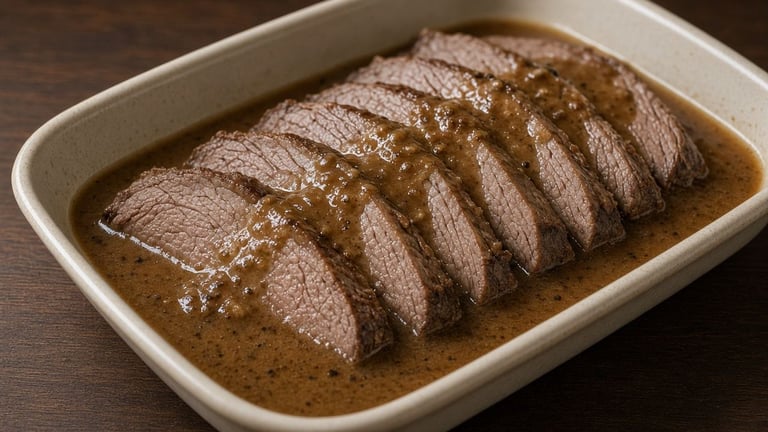
Partly. A prime rib that has gone past medium will not get its pink center back, and nothing you do to a finished roast puts the juice back in the fibers. What you can do is slice it thin, across the grain, and warm the slices in beef jus so every bite arrives wet. Thin and sauced is the version of overcooked rib roast people actually enjoy. A thick, dry slab is not.
Slicing and warming what you have
Do not put the whole roast back in the oven. It is already past where you wanted it, and more heat finishes the job.
- Let it rest first if it is just out. Tent it with foil for 20 minutes so the juices settle and the slices hold together.
- Slice thin. Cut across the grain, about an eighth to a quarter inch (3 to 6 mm), with the bones removed. Short fibers read as tender in the mouth; long ones read as dry.
- Warm the jus, not the beef. Heat the pan drippings, or beef stock, to steaming but below a simmer. Lay the slices in a shallow dish and ladle the jus over them, a third of the way up, for a couple of minutes. Boiling liquid tightens the meat again.
- Serve with horseradish and plenty of jus. Sharp and wet covers a lot.
The leftovers are where overcooked rib roast does best. Dry slices make a very good French dip, beef hash, or a sandwich with something creamy on it. Fat and sauce do what the muscle no longer can.
Why it overshot
A rib roast is a big, dense block of meat, often four to eight pounds and several inches through the middle. Heat reaches the center only by conduction, one layer at a time, so by the time the middle is where you want it the outer layers have been hotter for a long time. That stored heat does not stop when the roast leaves the oven. It keeps moving inward, and carryover cooking on a roast this size commonly adds 5 to 10°F (3 to 6°C) to the center, more if the oven was hot. A roast pulled at 135°F (57°C) for medium-rare finishes near medium, and one pulled at 140°F (60°C) goes past it. Resting does not undo that. The rest is when the rise happens, which is why the pull number sits below the finished one.
The gray band
The gray ring under the crust is beef the heat reached early and kept hitting. Raw red myoglobin turns pink as it warms and brown-gray as it goes past roughly 150°F (66°C), the same change from red to brown you see in a well-done steak. Two things widen it.
- A hot oven. At 450°F (230°C) the outer inch is well past done long before the center warms up. At 225 to 250°F (107 to 121°C) the temperature gradient is gentle, and the pink runs nearly to the edge.
- A cold center. A roast straight from the refrigerator is near 38°F (3°C) in the middle. The outside has to overcook while the core catches up. Let it sit out for 1 to 2 hours first, or cook it low enough that the gap does not matter.
Why it is tough, not just dry
People expect a tough roast to be undercooked. With prime rib it is nearly always the opposite. This cut is well marbled with little connective tissue, so it is tender from the start. It turns tough only when the muscle proteins tighten and wring out their water, which begins around 140°F (60°C) and speeds up from there. Past medium, the meat you are chewing is mostly squeezed fibers.
The exception is the cap and the fat seam. Fat that has not warmed enough stays waxy and chewy, so a roast that is rare in the center can still have a chewy edge. That is a different complaint, and it eats better with a hotter sear at the end.
Pull temperatures that work
Measure at the center of the thickest part, away from the bone, with a probe thermometer. Then pull earlier than the finished number.
| Doneness | Pull at | After a 30 to 45 minute rest |
|---|---|---|
| Medium-rare | 120 to 125°F (49 to 52°C) | 130 to 135°F (54 to 57°C) |
| Medium | 130°F (54°C) | 140 to 145°F (60 to 63°C) |
A roast cooked in a hot oven carries more stored heat in its outer layers and climbs further after it comes out, so pull it at the low end of the range. A big roast in a slow oven can go at the high end.
What to change next time
Roast low and sear at the end. Cook at 225 to 250°F (107 to 121°C) until the center is 10 to 15°F (6 to 8°C) below your pull, then rest it, then crisp the crust in a 500°F (260°C) oven for 6 to 10 minutes just before carving. That gets the brown crust without a gray band under it.
Start from the middle, not the clock. Roasts vary too much in shape and starting temperature for minutes per pound to hold. Put a leave-in probe in before it goes in the oven and watch the number.
Take it out of the fridge early. One to two hours on the counter closes most of the gap between the surface and a cold core.
Plan the rest. A 30 to 45 minute rest under loose foil keeps a big roast warm enough to serve, so a roast that finishes early is not a problem. A roast carved at the oven door is.