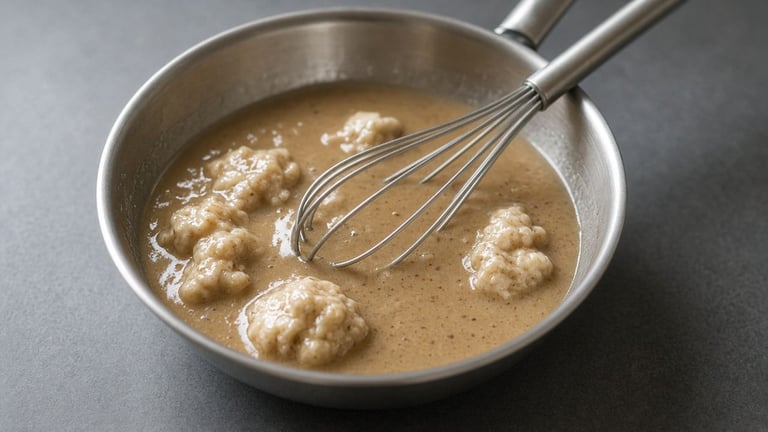
Almost every gravy problem is recoverable, with two exceptions. A gravy that scorched at the roux stage tastes bitter and has to be started over. A gravy that went far past salty can be diluted, but only so far. Lumps, thin gravy, thick gravy, and a slick of grease are texture problems, and texture can be repaired in the pot.
Lumps: strain, whisk, or blend
A lump is a pocket of dry flour with a gelled shell. Flour that meets hot liquid all at once swells on the outside first, and that wet layer seals the dry flour inside before the liquid can reach it. Two things cause this. A roux that was not stirred smooth before the stock went in, and a slurry or flour dumped into liquid at a rolling boil instead of being stirred in gradually. The thickening itself is just starch swelling and setting, and a lump is starch that swelled before it spread.
Work down this list and stop when the gravy is smooth.
- Whisk off the heat. Pull the pot, then whisk hard, getting into the corners where lumps hide. Small, soft lumps often dissolve in 30 seconds.
- Strain. Pour through a fine-mesh strainer into a clean pot and press on the solids with a spoon. This always works, and costs a little body, so thicken again if it needs it. Don't use this one for a gravy full of onions or mushrooms, which belong in it.
- Blend. An immersion blender takes 15 to 20 seconds in the pot. A countertop blender works too, but fill it no more than halfway, leave the lid vented under a towel, and expect some foam that settles after a minute. It turns onion and mushroom gravy into something closer to a purée.
Don't keep cooking a lumpy gravy and hope. Heat finishes setting the lumps instead of dissolving them.
Too thin: it hasn't set yet, or it never had enough flour
Flour thickens a gravy only after the liquid has come to a simmer and stayed there. Pan gravy from a roux is not done at the moment it looks right. The turkey gravy recipe on this site calls for 5 to 8 minutes of simmering, whisking often, and a gravy pulled at 2 minutes will be thin and then thicken on the table.
The ratio it is built on is about 1 to 2 tablespoons of flour per cup of liquid, with roughly as much fat by weight as flour. The turkey gravy sits at the thick end, around 2 tablespoons per cup. The Salisbury steak sauce sits at the thin end, about 1 tablespoon per cup. If your batch is thinner than you want after a full simmer, it does not have enough starch in it.
Add more starch the way you'd add it to a fresh pot, as a slurry. Stir 2 teaspoons of cornstarch into 1 tablespoon of cold water per cup of gravy, pour it in while stirring, and simmer 1 to 2 minutes. Flour works too, at 1 tablespoon per cup, but it needs the longer simmer, and it tastes raw if you rush it. Roux and slurry behave differently here, and a slurry is the faster rescue.
Gravy tightens as it cools. Aim for one that coats a spoon while hot but still runs off it.
Too thick: thin it with warm stock
This is the easiest repair there is. Whisk in warm stock, 2 tablespoons at a time, until it pours the way you want. Use warm stock, not cold, so the pot doesn't stall and lump. Thickened gravy left to sit will keep tightening, so thin it a little past where you want it. If you have to add more than about a cup to a 4-cup batch, taste it. The gravy will have gotten less salty and less rich along with thinner, and may want a pinch of salt and a splash of whatever flavor it lost.
Too salty: dilution is the only fix
Salt is a concentration, and it doesn't evaporate. Simmering a salty gravy makes it saltier, because the water leaves and the salt stays. Reduced store-bought stock is the usual cause, especially regular broth rather than low-sodium, and the second most common is salting the pot before the gravy has reduced.
What works is adding liquid that has no salt in it, plus a way to thicken it back. Each cup of unsalted stock or water added to a 4-cup pot cuts the saltiness by a fifth. Two cups cuts it by a third. Add the liquid, then restore the body with a slurry, and taste again before adding more. Cream or a spoon of unsalted butter makes the salt read as softer, though the salt is still all there.
A raw potato does less than its reputation. It absorbs gravy at the same saltiness the gravy already had, so it removes salt only in proportion to the liquid it takes up, which is not much.
The limit is about double the volume. Beyond that the gravy is more diluting liquid than gravy, and the flavor is gone with the salt. At that point, make a fresh, unsalted batch and use a cup or two of the salty one as the seasoning in it.
A heavy pour of Worcestershire sauce can make gravy taste sharp and too salty at once, and that one is its own diagnosis, which is published separately.
Greasy: the fat never joined the gravy
A greasy gravy has more fat than the starch can hold. In a roux gravy, the roux's flour is what carries the fat, and drippings add fat on top of the roux's own. Past about 1 tablespoon of fat per tablespoon of flour, the extra floats instead of mixing in. A gravy that has split into a slick on top and thin liquid underneath is the same problem, with the added step of a gravy that boiled hard or sat. It is the cousin of a sauce that won't emulsify.
- Tilt the pot so the fat pools on one side, and skim it with a wide spoon or a ladle. A paper towel laid flat on the surface for a second takes the thin film.
- If the gravy is separated rather than slicked, take it off the heat, and whisk in a splash of hot stock, about 1/4 cup, then blend for 15 seconds.
- For a lot of drippings, use a fat separator or chill the stock and lift off the fat before it goes into the roux. The turkey recipe keeps about 1/4 cup of fat from the drippings and skims the rest.
If you add more flour or slurry to bind the fat, remember the gravy gets thicker too.
What can't be saved
- Scorched roux. Dark brown flecks, or a smell like burnt toast, mean the flour burned in the pan. The bitterness spreads into everything you add to it. Start over. A roux cooked 1 to 2 minutes should still be pale gold. Browning one on purpose is a different, slower job.
- A gravy built from a burnt fond. The same goes for a deglazed sauce that tastes bitter. Scraping up black bits puts the black in the gravy.
- Salt beyond the double-the-volume limit described above.
What to change next time
- Cook the flour in the fat for 1 to 2 minutes before any liquid goes in. This is where the raw taste leaves.
- Add the stock gradually, whisking, and put warm stock into a roux that is not scorching hot. Cold liquid into a hot roux, or hot liquid into a cold one, is the setup for lumps.
- Make a slurry with cold water, and stir it into liquid that is hot but not boiling hard.
- Under-salt until the end. Taste after the gravy has simmered and reduced, not before. Use low-sodium stock, since stock and broth are not the same salt level.
- Simmer the full 5 to 8 minutes before deciding it is thin.