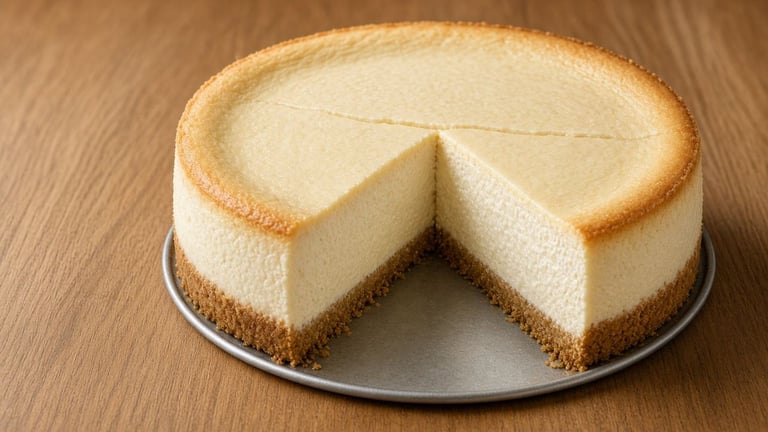
A cracked cheesecake can't be repaired, but it can be covered, and it is still good to eat. The split is cosmetic. It means the custard went past set and pulled apart as it shrank, not that the cake is raw or spoiled. Chill it completely, put something over the top, and nobody at the table will ask.
What a crack actually is
A cheesecake is a dense baked custard: cream cheese, eggs, and a little dairy. The eggs are what set it. Their proteins unfold and link into a mesh, and the mesh holds the fat and liquid in place. It works like any baked custard: the mesh keeps tightening as long as it is hot, and a tighter mesh squeezes out water and shrinks.
That shrinking is the crack. The cake sits in a pan with a wall that grabs it. As the surface contracts it has nowhere to go, and the weakest point, usually the center or a line running outward from it, gives way. A fissure is just a custard tearing under its own tension.
Three things push a cheesecake into that state.
Overbaking. The longer the custard stays hot past set, the tighter the mesh and the more it shrinks later. A cake baked until the middle is firm has already used up its slack. Carryover heat keeps cooking it after it leaves the oven, so a center that looks done at the oven door is overdone by the time it cools.
A sudden temperature drop. Pulling a 325°F (165°C) cake into a cool kitchen, or into a refrigerator, makes the outside shrink before the inside does. The skin on top contracts hard against a still-hot center.
Too much air. Whipping the batter, especially after the eggs go in, traps bubbles. They swell in the oven, lifting the cake, then collapse as it cools. A cake that puffed up like a soufflé will fall, and the fall tears the surface.
Is it still good?
Yes. Cut into it and look at the texture, not the top.
| What you see | What happened | Verdict |
|---|---|---|
| Thin hairline crack, creamy inside | Slight overbake or fast cooling | Perfect to eat, hide it if you like |
| Wide crack, edges pale yellow and slightly grainy | Baked well past set | Fine to eat, a little dry. Serve with something wet |
| Crack plus a deep dip in the center | Air collapsed after baking | Eat it, cover it, mix gentler next time |
| Wet, soupy center under a crack | Underbaked, not overbaked | Back in the oven, see below |
A cheesecake that is runny in the middle and cracked at the edge is not the overbaked case. Return it to the pan if you can, or chill it overnight first: a cold, underdone cake often firms enough to slice. If it is still liquid after that, bake it again at 300°F (150°C) for 15 minutes.
Covering a crack
Wait until the cake has chilled for at least 4 hours. A warm cheesecake will melt anything you spread on it.
Sour cream topping. Stir 1 cup (240 g) sour cream with 2 tablespoons sugar and a teaspoon of vanilla. Spread it over the cooled cake. It fills cracks up to about a quarter inch (6 mm) and adds a tangy layer that suits a dense cake. Some recipes bake it for 5 to 8 minutes at 350°F (175°C) to set it. You don't need to, and the extra heat on an already shrunk cake is exactly what you are trying to avoid.
Fruit. Cherries, macerated strawberries, or a spoonful of compote hide anything. Add it right before serving, because the juice runs into the cake and turns it soggy.
Ganache or caramel. A thin pour of chocolate ganache or caramel sauce covers wide cracks and is the best option for a deep one. Let it set in the refrigerator before slicing.
Whipped cream. Pipe or spoon it over the top. Fast, and it works on a dip in the middle as well.
None of these seals the crack. They sit on top of it. If you cut a slice through the split, it will still be there, and the cake is still a cake.
What to change next time
Pull it when the middle still wobbles. The edges should be set for about 2 inches (5 cm) in, and the center should jiggle like barely set gelatin when you nudge the pan. The middle of the cake should read around 150°F (65°C) on an instant-read thermometer. A dry-looking, firm center means it is already overbaked. It firms up as it cools.
Use a water bath, or a low oven. Set the springform pan inside a larger pan and pour hot water halfway up the side. Wrap the pan in two layers of foil first so water can't seep in. The water holds the pan near 212°F (100°C), so the edges can't overheat while the center catches up. Without a water bath, bake at about 300°F (150°C) and expect a longer time, often 70 to 90 minutes for a 9-inch (23 cm) cake. Sitting a pan of hot water on the rack below also helps, and a lot of the benefit is just humidity keeping the surface from drying and tightening.
Mix the batter on low speed. Beat the cream cheese and sugar smooth first, then add the eggs one at a time on the lowest speed, only until each one disappears. Scrape the bowl between additions. Everything should start at room temperature, around 70°F (21°C), so you aren't beating lumps out of cold cream cheese, which is what makes people mix too long.
Free the edges, then cool in steps. The moment the cake leaves the oven, run a thin knife around the inside of the pan to release it from the wall. Then turn the oven off and leave the cake inside with the door cracked open for about an hour. Move it to the counter until it reaches room temperature, then refrigerate for at least 6 hours, overnight is better. Rushing any of those steps brings back the temperature drop.
Do not open the door early. Cold air on a half-set cheesecake does the same damage as moving it too soon. Check at the late end of the time range, through the glass if you have it.