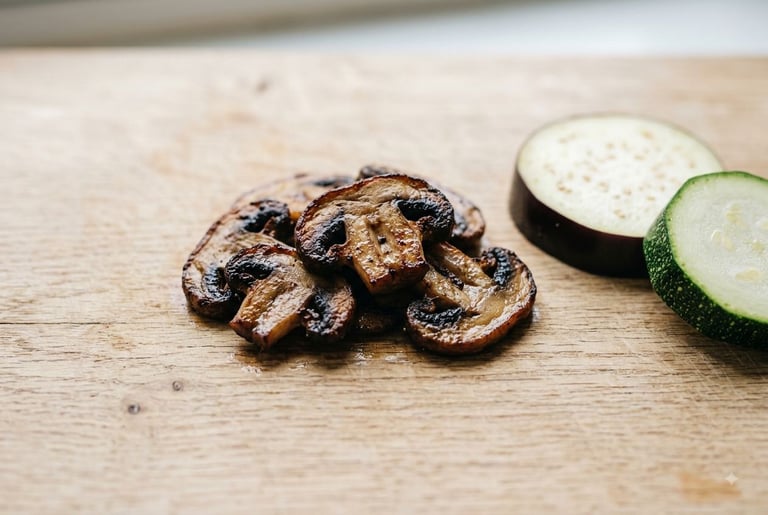
A mushroom in a dish is doing one of three things: adding a meaty chew, adding savory depth, or just adding bulk, and the right substitute depends entirely on which one it is. Eggplant and zucchini can fake the chew. Miso, soy sauce, and tomato paste can fake the savoriness. Nothing fakes both, and a dish where mushrooms are the entire point — duxelles, a mushroom risotto — doesn't really have a substitute at all.
Why mushrooms chew like meat and vegetables don't
Most vegetable cell walls are cellulose. A mushroom's are chitin — the same polymer that makes up a crab shell or an insect's exoskeleton, because a mushroom is a fungus, not a plant, and fungi build their walls out of different stuff. That's the reason a mushroom holds a firm, almost fibrous bite even after it's given up most of its water, while a zucchini given the same heat collapses into something soft and slick.
Slice mushrooms into a hot, dry pan and the first few minutes are just water leaving the cells. Once most of it's gone, what's left is a dense mat of chitin and protein sitting in direct contact with a hot pan, and that's when the Maillard reaction takes over and the pieces turn brown, meaty, and slightly crisp at the edges. Crowd the pan and they steam instead, turning grey and rubbery. The recipes on this site that call for mushrooms cooked until "browned," not just "softened," are asking for that second stage — not skipping past it.
The other job: savoriness with nothing to chew
Separately from texture, mushrooms carry real free glutamate, the amino acid behind savoriness and the same compound concentrated in parmesan, soy sauce, and a good stock. Dried mushrooms go further. Drying concentrates the glutamate and also produces guanylate, a nucleotide that multiplies rather than adds to glutamate's effect when the two are tasted together — the same synergy that makes a kombu-and-katsuobushi broth taste more savory than either ingredient alone. It's why dried shiitake dropped into a simmering ramen broth are doing pure flavor work; nothing of their texture ends up in the bowl.
This is the job most of the substitutes below get right by accident. Miso, soy sauce, and tomato paste are all concentrated glutamate in some form, so they restore the savoriness a mushroom was adding to a sauce even though none of them chew like anything.
What each substitute actually trades away
| Substitute | Replaces | Ratio | What you're trading |
|---|---|---|---|
| Eggplant or zucchini, salted and pressed 15–20 minutes | Meaty chew and bulk | 1:1 by weight | Extra water where mushrooms had none — skip the salting and it waters down the dish instead of thickening it |
| Firm tofu, pressed and cubed | Chew without added water | 1:1 by weight | No savoriness on its own — bland until it's paired with something else on this list |
| Miso, whisked into a little warm liquid before adding | Savoriness only | 1 tablespoon per 8 oz (226g) mushrooms omitted | Zero texture or bulk, plus miso's own fermented tang |
| Soy sauce | Savoriness only | 1–2 teaspoons per 8 oz (226g) omitted | Same trade as miso, plus extra sodium and a darker color |
| Tomato paste, cooked a minute to lose its raw edge | Savoriness and some body | 1–2 tablespoons per 8 oz (226g) omitted | Adds acidity and sweetness mushrooms never had |
| Dried kombu, steeped in the liquid and removed | Savoriness only, in broths and braises | one 2-inch piece per quart of liquid | Does nothing in a sauté — only works where there's liquid to steep it in |
Where nothing really replaces the mushroom
Duxelles is the clearest case. The paste inside a Beef Wellington, or a mushroom and chestnut version of one, is chopped mushroom cooked down for ten minutes or more until the liquid's gone and what's left is dense, dark, and pasty. That paste is the layer; it isn't standing in for anything else. Eggplant reduced the same way turns into something closer to baba ghanoush, and no combination of miso and tofu produces that same dark, meaty spread. Without mushrooms, the honest options are to buy some or skip the layer, not to improvise one.
Stuffed portobellos are the same problem in a different shape. The mushroom is the vessel as well as the flavor, so "substitute for the portobello" isn't really a smaller version of the same question — it's a different dish.
A cream sauce built around mushrooms, like a stroganoff, asks for both jobs at once: the browned chew and the savory depth. Eggplant or zucchini can approximate one of those and tofu or miso the other, but stacking three substitutes to cover both jobs changes the sauce more than swapping any single ingredient ever does. At that point it's usually more honest to make a different sauce than to chase the original one this hard.