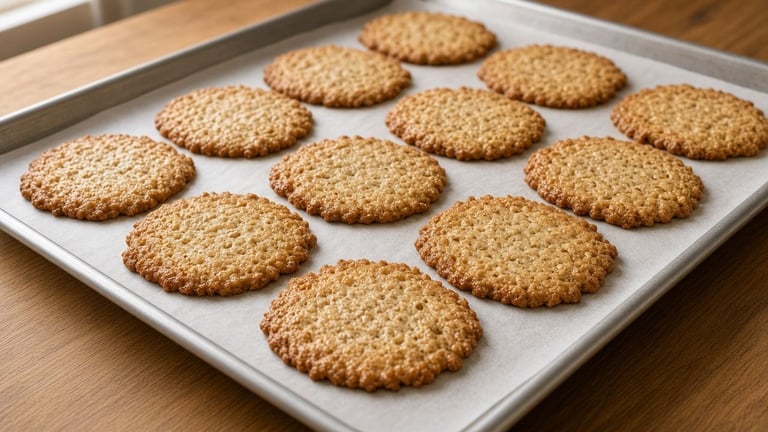
If the dough is still unbaked, you can save it. Chill what's left in the bowl, bake one cookie as a test, and adjust. Cookies that already spread into thin lace are done for as cookies. They can't be reshaped once they've set, though they make excellent crumbs. Either way, the fix is mostly temperature.
Why the dough ran before it set
A cookie holds its shape through a race. The butter melts and the dough starts to flow, and in the oven, the eggs coagulate and the flour's starch swells and sets. Whichever finishes first decides the cookie. If the structure sets while the dough is still thick, you get a round, tall cookie. If the fat melts first and the dough has already slumped across the sheet, it sets thin and wide.
Anything that gets the fat liquid sooner, or the structure later, tips the race the wrong way. That's what all the usual causes have in common. In cookies, the dough doesn't have far to go before it hits the sheet.
What tips it
Butter that was too warm. Butter starts to soften around 65°F (18°C) and is largely melted by the mid-90s°F (about 35°C). A kitchen at 80°F (27°C) puts "softened" butter well on its way to greasy. Properly softened butter is cool to the touch and dents under a finger without squishing through.
Melted butter where the recipe wanted softened. Creaming softened butter with sugar beats thousands of tiny air pockets into the fat. Those bubbles puff in the oven, and the solid fat holds the dough up while it bakes. Melted butter has neither. It's fine in a recipe built for it, which usually has more flour or a rest to compensate, but swapping it in makes cookies thin.
A warm pan. A baking sheet fresh from the last batch starts melting the next batch's butter before it ever reaches the oven. Run it under cold water and dry it, or rotate between two sheets.
Not enough flour. Flour is the structure. A cup scooped straight from the bag can be off by 20% or more in either direction, and too little leaves a loose dough. Weigh it if you can: about 120 to 125 g per cup. Otherwise spoon flour into the cup and level it.
Too much sugar, or the wrong leavening. Sugar liquefies as it heats and thins the dough further. Baking soda raises the dough's pH, which loosens the proteins and encourages spread, so an old, over-measured, or substituted leavener can change the outcome. If you swapped one for the other, that may be it.
Greased pans. Extra fat on the pan gives the dough a slide. Parchment grips and spreads less.
An oven that runs cool. At a true 325°F (165°C), the butter has far longer to melt before the structure sets. An oven thermometer would tell you.
Saving the dough that's left
- Stop baking. Put the remaining dough in the refrigerator, now.
- Portion first, then chill. Scoop the balls onto a parchment-lined plate or tray and chill at least 30 minutes, ideally 1 to 2 hours. Dough pressed into a cold bowl takes hours to cool through, but separate balls firm up fast.
- Check the feel. The balls should be cold and firm, like cool modeling clay, with no greasy sheen. If they're still soft, wait.
- Bake one test cookie on a cool sheet at 350 to 375°F (175 to 190°C). A hotter oven sets the edges sooner, so there's less time to spread.
- If the test still runs flat, work in 1 to 2 tablespoons of flour per batch of dough, chill again, and retest. If it's thin and greasy rather than just wide, the butter was the problem, and flour will only help so much.
Dough that has sat in the refrigerator overnight is not a problem, and many cooks prefer the cookies it makes. Hydrated flour and fat that have had a day together bake up thicker and chewier.
What to do with flat cookies
A thin cookie is still a cookie, and the flavor hasn't changed. Cut or break them into pieces for ice cream, press crumbs with melted butter into a crust for a cheesecake, or layer them with cream in a trifle. If they just came out of the oven, you have about a minute: nudge the edges in with a round cutter or the rim of a glass, and they'll firm up closer to round.
What to change next time
- Use butter at about 65°F (18°C), not warmer. In a hot kitchen, give it less time on the counter.
- Cream the butter and sugar for a full 2 to 3 minutes, until the mixture looks paler and fluffy.
- Chill portioned dough for 1 to 2 hours before baking. For thicker cookies, let it go overnight.
- Use cool sheets, with parchment, every batch.
- Weigh the flour, or spoon and level it.
- Check the oven. 350 to 375°F (175 to 190°C) is the working range for most drop cookies.
When the cookies won't spread
The opposite failure, tall pale mounds that stay put, has a mirror-image cause. Too much flour is the usual one. After that, dough chilled so hard it can't flow before it sets, too little sugar, and an oven that is too hot, which sets the outside before the middle can move. Press the ball down gently with your palm before baking, let hard-chilled dough stand for 10 minutes, and measure the flour with more care.