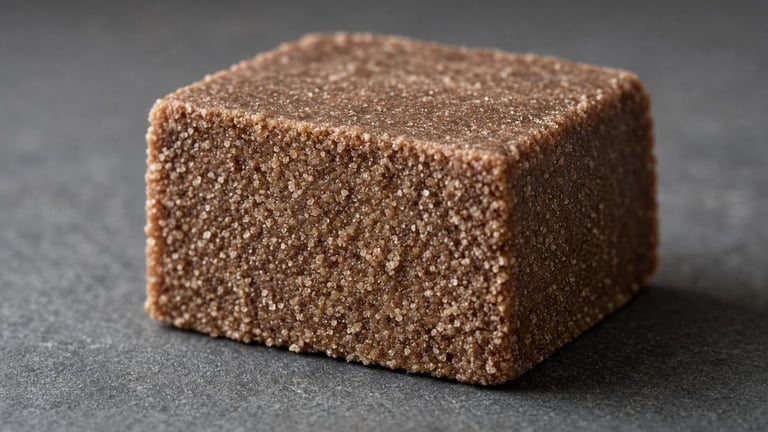
A grainy batch and a batch that never sets are both recoverable, once, by scraping the fudge back into the pot with a little milk and cooking it again to the right temperature. Grainy means the crystals came out large. Soft means too much water stayed in the syrup. Different failures, the same rescue, and the difference between them is a few degrees on a thermometer.
What fudge is supposed to be
Fudge is a sugar syrup that you let crystallize on purpose, in tiny crystals. That is the whole trick. Cooked and cooled right, the sugar sets into a mass of crystals so small your tongue reads them as smooth and creamy. Cooked or handled wrong, the same sugar sets into crystals big enough to feel. Same ingredients. Different crystal size.
The size is decided by two things. How many crystals start, and when. Crystals begin growing from any seed: an undissolved grain, a splash dried on the side of the pot, a spoon that scraped the wall. Left alone while the syrup is hot, a few seeds grow into a few large crystals, and that is grainy fudge. Cool the syrup undisturbed first, then beat it, and you start thousands of crystals at the same moment. None of them gets time to grow large. It is the same chain reaction that ruins a pot of caramel, with the goal reversed: here you want crystals, just not big ones.
Why a batch goes grainy
Three habits cause nearly all of it.
Stirring or scraping while the syrup is hot. After the sugar dissolves and the pot comes to a boil, put the spoon down. Syrup scraped off the side dries into crystals, and those fall back in. Wipe the sides with a wet pastry brush instead.
Beating too early. Fudge beaten while it is still near boiling grows coarse crystals, because the hot syrup lets them grow fast and large. Let the pot cool, undisturbed, to about 110°F (43°C) before the spoon goes in. That is lukewarm to the touch on the outside of the pot. It takes 30 to 45 minutes, and it is the step people skip.
Skipping the doctoring. Corn syrup, butter, and a little acid get in the way of crystal growth. Most recipes include them for that reason. Cut the corn syrup and the margin for error shrinks.
Why a batch stays soft
Setting depends on how much water is left in the pot when you stop cooking. Boil off more water and the finished fudge is firmer. The target is the soft-ball stage, 234 to 240°F (112 to 116°C), and most recipes pick 236°F (113°C) as the number.
| Pulled off at | What you get |
|---|---|
| Under 232°F (111°C) | Pudding. Never sets, spoonable at best |
| 234–238°F (112–114°C) | Firm but creamy, cuts cleanly |
| Over 242°F (117°C) | Dry, crumbly, sometimes hard |
Two other things throw the number off. A thermometer that reads wrong by five degrees will hand you soft or crumbly fudge while you believe you did everything right. Test it in boiling water, which should read 212°F (100°C) at sea level. And altitude: water boils about 1°F lower for every 500 feet you climb, so subtract the same amount from your target at elevation. Humid days make fudge soft too, because the surface absorbs moisture from the air.
How to rescue a grainy or soft batch
Scrape the whole batch back into the pot. It will be a stubborn lump. That's fine.
- Add ½ cup of milk or cream per batch of about 2 pounds (900 g).
- Warm it over low heat, stirring until every crystal has dissolved and the mixture is smooth. Check the spoon and the bottom of the pot for grit.
- Bring it to a boil and stop stirring. Cook to 236°F (113°C).
- Take it off the heat, add no more butter, and let it cool undisturbed to 110°F (43°C).
- Beat with a wooden spoon until it thickens and loses its gloss, then pour it into a lined pan right away.
Do it once. A second re-cook darkens the flavor, because milk sugars scorch, and the fudge ends up chewy rather than creamy. If the batch is hard and crumbly instead, step 1 is the same, with 3 or 4 tablespoons of liquid instead of half a cup.
If you'd rather not start over, grainy fudge makes a good ice cream swirl, stirred into warm milk for hot chocolate, or crumbled into brownie batter. The sugar is fine. Only the texture is off.
What to change next time
Use a candy thermometer and trust it over the clock. Fit it so the tip sits in the syrup and not on the bottom of the pot, and use a heavy pot at least three times the volume of the syrup, because it foams. Stir until the sugar dissolves, then stop. Cook to 236°F (113°C) and take it off the heat. Do not stir, do not scrape, do not taste with the stirring spoon. Cool to 110°F (43°C), then beat.
Watch for the point where the shine goes dull. That is the crystals taking hold, and it is the signal to pour, not a signal to beat a bit more. Once it starts to stiffen it moves fast, so have the pan lined before you begin.
Marshmallow-cream fudge is the exception. It skips the crystal-size game entirely, and a short boil and a quick stir are all it needs.