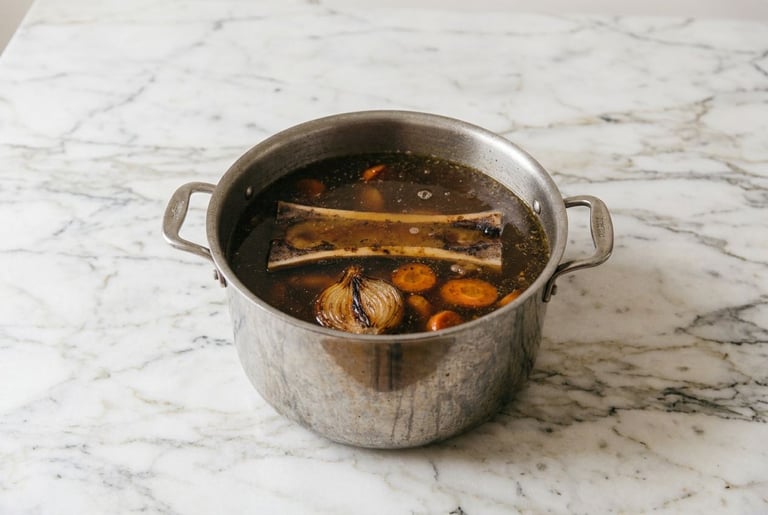
Beef stock is built on a ratio, not a recipe: roughly two pounds of bones to one quart of water, roasted first until they're a deep mahogany brown, then simmered — never boiled — for eight to twelve hours. You know it worked when a spoonful chilled in the fridge sets into a loose, trembling gel instead of staying liquid, and that test matters more than any number of hours on the clock.
The ratio, and why the bones go in the oven first
Scale a batch up or down and the two-to-one ratio of bones to water is what you're actually scaling — everything else is seasoning around it. Spread the bones in a single layer and roast at 450°F (232°C) for 45 to 60 minutes, turning them once, until they're a deep reddish-brown at the edges, close to the color of a well-worn saddle. That color is the Maillard reaction, the same browning that happens on a seared steak, and it's where most of beef stock's roasted, savory character actually comes from. Add the tomato paste to the pan for the last 10 minutes and it browns too, turning from bright red to brick and losing its raw tang along the way. Skip this step and the stock isn't wrong, exactly — it's just thinner in flavor and pale enough to look like a different ingredient.
Why it simmers instead of boils
Once the bones are in the pot, the target is a bare simmer: small bubbles breaking gently at one edge of the surface, somewhere around 180°F to 200°F (82°C to 93°C), not the rolling boil you'd use for pasta water. A hard boil agitates the liquid enough to beat rendered fat into tiny droplets that stay suspended instead of rising and pooling on top, and that emulsion is what makes a stock look muddy and taste greasy rather than clean. A gentle simmer lets fat collect where you can skim it and lets flavor extract slowly, without breaking anything into the liquid that doesn't belong there.
Skimming in the first hour
For the first 30 to 60 minutes, gray foam will rise steadily to the surface — that's coagulated protein forced out of the bones by heat, and it's the main thing standing between a clear stock and a cloudy one. Ladle it off every few minutes while it's still floating loose. Once the simmer settles in and the foam stops appearing, you can mostly leave the pot alone; anything left behind at that point gets churned back into the liquid instead of settling, and there's no skimming your way out of it later.
What joints and connective tissue give you that a lean bone can't
A marrow bone tastes rich but sets thin, because marrow is mostly fat and fat doesn't gel. The gel comes from collagen, and collagen is concentrated in joints, feet, and cuts like oxtail and shin that do a lot of mechanical work on a live animal. Long, gentle heat hydrolyzes that collagen into gelatin, which dissolves into the water and stays there. A stock made only from marrow bones can taste fantastic and still refuse to set — it's missing the structural part, not the flavor part.
How to know it's done — the gelatin test
Somewhere past the eight-hour mark, ladle a small spoonful into a bowl and put it in the fridge for an hour. If it firms into a soft, jiggly gel, the stock has pulled enough gelatin out of the bones and it's done. If it's still liquid, it isn't — put the pot back on and check again in another hour or two. Bones vary enough in size and collagen content that two batches started the same way can finish an hour or two apart, which is exactly why the chilled spoonful is the real test and the clock is only ever a guess.