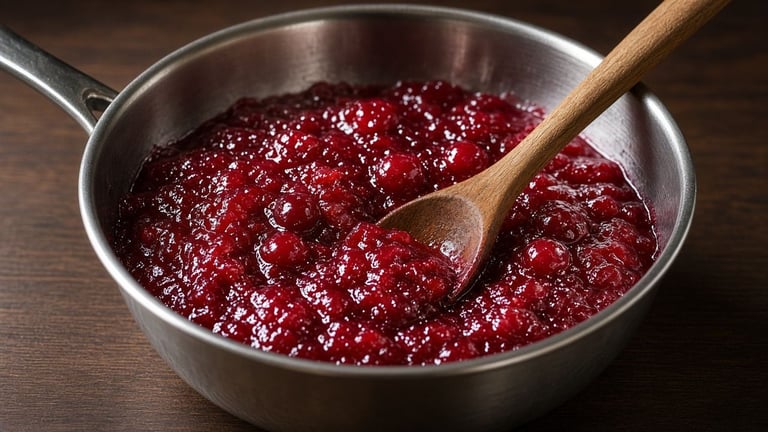
A too-tart, too-runny, or too-thick saucepan of cranberry sauce can almost always be saved, and it takes about ten minutes on the stove. Bitter is the one that sometimes can't be: if the berries were cooked hard for 20 minutes or more, you can dull it but not remove it. Sour and loose usually share a cause, so check both before you reach for the sugar.
Why cranberries are sour and why the sauce sets
A cranberry is about as acidic as fruit gets, and it is also packed with pectin, the same thing that sets jam. Both are in the berry's skin and cell walls. Raw, they stay locked in. Heat softens the walls, the berries pop, and the pectin leaks into the liquid around them. What acid does to food in general is a topic of its own. Here the part that matters is that pectin sets only when there is enough acid and enough sugar in the liquid to pull water away from it. Cranberries bring the acid. The sugar is yours.
So sugar in a cranberry sauce is doing two jobs. It sweetens, and it is what lets the sauce gel. A sauce short on sugar is sour and also looser than it should be, which is why the two complaints show up together.
Sour: sweeten on the stove, not in the bowl
Stirring sugar into finished, cooled sauce leaves grit, and it never quite blends in. Put the sauce back over medium-low heat instead.
- Add 1 tablespoon of sugar and 1 tablespoon of water or orange juice. The sugar needs liquid to dissolve into.
- Simmer 2 minutes, stirring.
- Take a spoonful, let it cool for a minute, and taste that. Cold mutes sweetness, and a sauce is served at room temperature or colder.
- Repeat until it reads right. If it needs more than about 1/4 cup in total, it was under-sugared from the start. Simmer a little longer after the last addition so it all dissolves.
For scale, a tart sauce runs about 1/2 cup of sugar (100 g) per 12-ounce (340 g) bag of berries, and the classic sweet one uses a full cup (200 g). Maple syrup and brown sugar in place of some of the white works the same way and adds flavor.
Salt, fat, and orange change how the tartness is perceived rather than removing any acid. A small pinch of salt rounds the edge, and salt is the classic way to make bitterness harder to taste. A tablespoon of butter smooths it. Orange zest adds fragrance that makes the sauce taste fuller. Orange juice is itself acidic, so it fills the pot but doesn't sweeten it. Baking soda does neutralize acid, and 1/8 teaspoon will foam and flatten the flavor, but past that it tastes soapy and dulls the red. It is a last resort.
Runny or didn't set: it is probably not done cooking
Cranberry sauce is done when almost every berry has burst, which takes about 6 to 8 minutes at a steady simmer. A sauce pulled at 4 minutes has whole berries holding their pectin inside them, and it will stay loose however long it sits.
If the berries have all burst and it is still thin, there is too much liquid for the sugar to work against. Cook it uncovered for 5 more minutes. Don't judge it hot. It thickens a great deal as it cools, so use a plate test instead. Put a small plate in the freezer, drop a teaspoon of sauce on it, wait a minute, and tilt. A sauce that is going to set barely slides, and the surface wrinkles when you push it with a finger. If it runs, simmer 3 to 5 minutes longer and test again. Then let the batch sit in the refrigerator for a few hours before you decide it failed.
Too thick or pasty: it reduced too far
Past the set point, the sauce keeps losing water and goes from jelly to paste. Warm it over low heat and stir in water or orange juice, 1 tablespoon at a time, until it drops from a spoon in a slow ribbon. Stop slightly looser than you want. It tightens as it chills, and a sauce that is perfect hot is stiff cold.
Bitter: sometimes recoverable
Two things make cranberry sauce bitter. One is cooking too hard and too long. Pushed well past the point where the berries pop, the skins and seeds give up bitter compounds. The other is under-ripe fruit, which was never going to be sweet. Zest taken too deep, into the white pith, adds more.
You can't take bitterness out. What helps is to cover it:
- A little more sugar and a small pinch of salt. Salt dulls bitterness.
- Stir in a tablespoon of butter or a few tablespoons of orange juice, which add roundness and aroma.
- If it is badly bitter, cook a fresh half-batch and stir the two together so the bitter one is diluted.
A sauce that went dark and acrid from scorching on the bottom of the pot can't be rescued, and a taste before serving will tell you which kind you have.
What to change next time
- Start with 1/2 to 1 cup of sugar per 12 ounces (340 g) of berries, and 1/2 to 1 cup of liquid. Hold some of the sugar back if the berries are very tart, and adjust at the end.
- Simmer 6 to 8 minutes, until nearly all the berries have burst, and then stop. Past 15 minutes you are only risking bitterness.
- Add zest at the very end, and take only the colored part.
- Judge set on a chilled plate, not in the pot.
- Make it a day ahead. It sets fully in the refrigerator, and you get to taste and fix it before the meal.