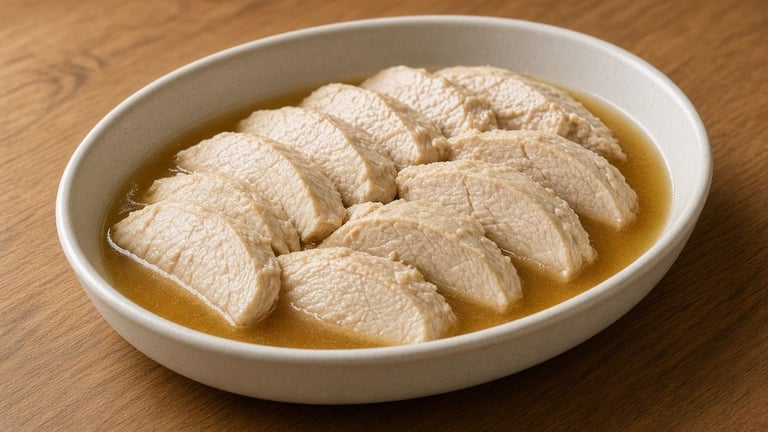
You can make a dry turkey taste much better, but you can't make it juicy again. Once the muscle fibers have tightened and squeezed their water out, that water is gone and no soaking puts it back. What you can do is put moisture around the meat instead of in it: thin slices, warm stock, plenty of gravy. It is a rescue, not a reversal, and the earlier you start the better it works.
What actually happened inside the breast
Turkey breast is lean and has almost no connective tissue to hold moisture. As it heats, the proteins tighten like a fist closing. Somewhere in the 140s to 150s°F (60 to 66°C) they begin to wring out water, and by the time the breast passes 165°F (74°C) it has lost a noticeable share of what it started with. That lost liquid is the pool of drippings in the roasting pan. It was supposed to be in the meat.
The thigh has the opposite problem. Dark meat is laced with collagen, which needs to reach roughly 175°F (79°C) before it loosens into something tender. Safe at 165°F (74°C), good at 175°F (79°C). So you have a bird whose two halves want different finish lines, and an oven that heats the exposed breast first. By the time the thigh is ready, the breast has often been done for a while.
Then the bird comes out. Carryover cooking keeps pushing the center up after it leaves the oven, and a big turkey is a deep reservoir of heat. Expect the breast to climb another 5 to 10°F (3 to 6°C) during the rest. A breast pulled at 165°F (74°C) commonly finishes in the low 170s°F (about 77°C), and that last stretch is where "fine" becomes "dry".
If the bird was also over-salted before it went in, that is a separate problem, covered under dry-brined meat that tastes too salty. This page stays on dryness.
Salvaging a carved turkey
Work in this order.
- Slice thin and across the grain. Short fibers feel less dry in the mouth than long ones. Cut slices about a quarter inch (6 mm) thick, perpendicular to the lines you can see running through the breast.
- Warm it in liquid, not in the oven alone. Lay the slices in an ovenproof dish, overlapping. Ladle warm chicken stock or turkey stock over them until the liquid comes about a third of the way up the meat. Cover tightly with foil and heat in a 325°F (165°C) oven until the meat reaches 165°F (74°C), about 15 to 20 minutes. The meat will not drink it back like a sponge, but the surface and the cut faces pick up enough to change how it eats. Keep the stock below a simmer; boiling it tightens the meat again.
- Serve with a lot of gravy. Dry turkey is why gravy exists, and gravy has its own failure modes, from lumps to salt to thickness.
- Move the worst of it into something wet. Overcooked breast does well chopped into soup, turkey and gravy over mashed potatoes, a creamy casserole, or turkey salad bound with mayonnaise. Fat and sauce do the job the muscle no longer can.
If the breast is dry but the thighs are only just done, carve the breast first and put it through the rescue above while the dark meat finishes. Dark meat forgives what white meat does not.
What to change next time
The goal is to let the breast and thigh each finish where they want to. Three levers, in order of effect.
Pull the breast earlier. Take the bird out when the thickest part of the breast reads 155 to 160°F (68 to 71°C) and rest it 30 minutes tented with foil. Carryover carries it past 165°F (74°C), and a long rest holds it there. Before you carve, check the breast, the innermost part of the thigh and the wing: the USDA's safe minimum for a whole turkey is 165°F (74°C) in all three. If the breast falls short after the rest, it goes back in the oven. The herb-butter turkey recipe on this site calls for 165°F (74°C) in both breast and thigh at the oven door, which is the conservative reading; the lower breast pull is for cooks who have a good thermometer and a long rest.
Slow the breast down. Cover the breast with foil once it has browned, or start the bird breast-side up with an ice pack on the breast for 30 minutes to give the thigh a head start. A lower oven, 325°F (165°C), narrows the gap between surface and center and leaves less to carry over.
Change the shape. A spatchcocked bird puts breast and thigh on the same plane, so they finish nearly together. Brining also helps: salt makes the muscle hold more water, which gives you a wider margin before it dries out.
Whatever you do, trust the thermometer at the thickest part of the breast and at the thigh near the bone. Color, wobble and clock time are three ways to miss.