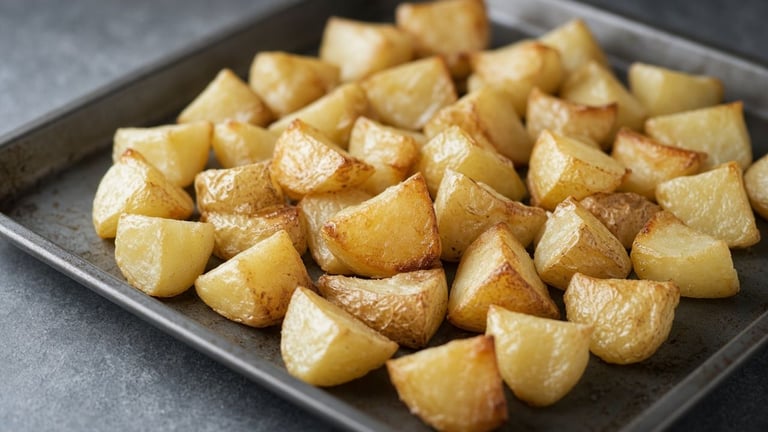
If the potatoes are already cooked through, the batch is almost always recoverable. They are soft inside, so all that is missing is a crust, and a crust is a surface job: spread them out, put them back into a 450°F (230°C) oven on a hot pan with a little more fat, and give them 15 to 25 minutes. If the middles are still firm, the fix is time first and heat second.
Why they came out soft
A roast potato's crust is not the potato browning. It is the outermost layer of cooked, gelatinized starch drying out completely and then frying in hot fat. Starch gelatinizes in the oven or the parboil, the surface sheds its water, and what is left cooks in the oil into something hard and glassy.
Water is the obstacle. A potato is about four-fifths water, and as long as there is liquid on the surface, that surface cannot get past 212°F (100°C), the temperature at which water boils off. The browning chemistry in the Maillard reaction needs far more than that, so a wet surface steams and stays pale however long it sits in the oven.
Three things keep the surface wet:
- Crowding. Potatoes that touch trap each other's steam. Every piece gives off water, and in a full pan it has nowhere to go.
- Wet potatoes. Water left from rinsing, from a parboil that wasn't drained and dried, or from liquid poured over them has to boil away before anything browns.
- Too little heat. An oven at 375°F (190°C) removes water slowly and never has surplus energy left over for the crust.
The same logic applies to the pan. Potatoes dropped onto a cold sheet pull heat out of it the way cold food does in a hot pan, and the fat around them never gets hot enough to fry.
Rescuing a soft or pale batch
- Heat the oven to 450°F (230°C) with a rimmed sheet pan inside. Give it 10 minutes.
- Tip the potatoes onto a cutting board or into a bowl and toss with 1 to 2 tablespoons of oil. Drain off and discard any liquid that has pooled in the pan. If the potatoes are sitting in it, that liquid is what is keeping them soft.
- Pour the potatoes onto the hot sheet in one layer, cut sides down, with a finger's width between each piece. They should sizzle on contact. If they don't, the pan isn't hot enough.
- Roast for 10 minutes without touching them, then turn each piece once. Another 5 to 15 minutes, until the surfaces are deep golden and the bottoms release without tearing.
If the outsides are browning faster than the middles are softening, drop to 400°F (200°C) and let the inside catch up. Potatoes that have gone limp from sitting covered in foil can be crisped this way too, though the second round gives a thinner crust than a first roast done right.
Why they stuck to the pan
Potatoes stick when you try to move them before the crust has formed. Raw starch grips metal. Once the surface browns and dries, it shrinks slightly and lets go. Leave them undisturbed for the first 20 minutes or so, then slide a thin metal spatula flat under each piece. A pan that was not preheated and potatoes with too little oil make it worse, since both leave the starch in direct contact with bare metal.
What to change next time
| What you saw | What was wrong | Next time |
|---|---|---|
| Pale, soft all over | Oven too cool, or pan crowded | 425–450°F (220–230°C); one layer with gaps |
| Limp on the bottom, pooled liquid | Potatoes wet when they went in | Steam-dry after draining; pat raw potatoes dry |
| Stuck and torn | Moved too early, or cold pan | Preheat the pan; wait for the crust |
| Dry and hard but not crisp | Not enough fat | About 3 tablespoons per 2 pounds (900 g) |
| Brown outside, hard inside | Pieces too big, or heat too high | Cut 1½ to 2 inches (4–5 cm); parboil |
A standard half-sheet pan holds about 2 pounds (900 g) of cut potatoes in a single layer. A bigger batch needs a second pan on a second rack, swapped halfway through. A sheet pan and a roasting pan behave very differently here, because a deep wall slows steam leaving the pan.
Should you parboil?
Yes, if you want a thicker crust, and the reason is worth knowing. Simmering cut potatoes for 8 to 10 minutes in salted water, until the edges are soft and a knife meets some resistance at the center, gelatinizes the outer layer and begins to break it down. Drain them, leave them in the colander for 5 minutes so steam carries off the surface water, then shake them hard in the pot so the soft edges scuff into a paste. More roughed surface means more crust.
Some cooks add about ½ teaspoon of baking soda per quart of water to speed that breakdown. It works, but the potatoes fall apart quickly, so pull them a minute early.
Parboiling only pays off if the potatoes go into very hot fat. Dry, scuffed edges dropped on a lukewarm pan soak up oil and go greasy.
Which fat
Any oil that handles 425°F (220°C) works: refined olive oil, canola, sunflower, avocado. Duck or goose fat adds flavor along with the crust. Extra virgin olive oil is fine for roasting but sits closer to its smoke point at 450°F, so use it for the lower-temperature rescue and keep the refined oil for the hottest oven. Whatever you pick, coat every cut face. Oil is the heat-transfer medium here, and a bare patch of starch will stay pale.
A note on neighbors
Smashed potatoes are a different dish: cooked through first, then flattened, so the cracked surface area is far larger and browns in about 20 minutes. They show how much crust is a matter of exposed surface and hot fat. Potatoes roasted in a splash of lemon juice or stock are another neighbor. The liquid has to cook off before browning starts, so the last 10 to 15 minutes of the roast do the work that the first 30 can't.