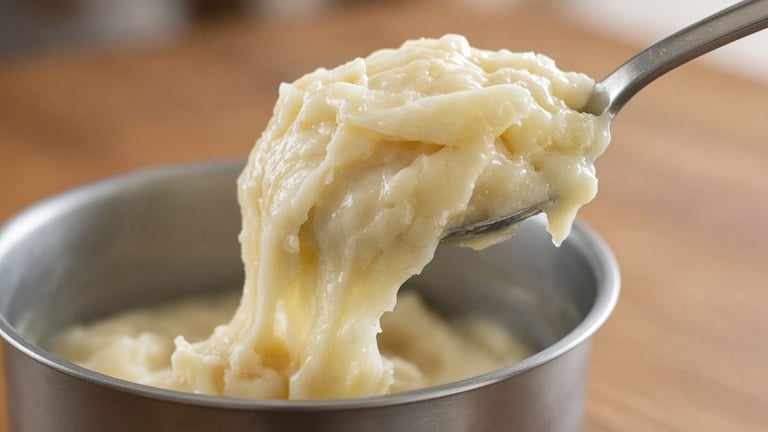
Gluey mashed potatoes can't be rescued as mash. No amount of stirring, extra butter or hot milk will bring back the fluffy texture, because the problem isn't the amount of liquid, it's starch that has already burst out of the potato's cells. What you can do is turn the batch into something that wants that texture: potato cakes, a baked topping, or a smooth soup.
That is the opposite of a pot of risotto, where you deliberately scrub starch off the rice into the liquid. Mash is a dish where the starch is supposed to stay inside the cells.
What went wrong inside the potato
A raw potato is mostly cells packed with starch granules. Cooking does the gelatinizing, the same reaction that thickens a sauce: granules swell, soften, and fill their cells. A well-cooked potato is a pile of soft, loosely connected little bags, each one full of swollen starch.
A ricer or a hand masher squeezes those bags apart without bursting many of them. The mash feels light because it is made of intact cells with air between them. A food processor, a blender or a mixer on high does something else: the blade slices cells open and spins the released starch into the surrounding liquid, where long, sticky starch chains tangle into a stretchy paste. Seconds are enough. The change isn't gradual, and there is no moment where it looks fine and then slowly gets worse.
Salvaging the batch
Thinning it with more milk will get you a looser paste, and the paste is still elastic. Pick a route that doesn't need fluffiness.
- Potato cakes. Spread the mash an inch thick in a pan, chill it until firm, cut it into rounds, dust with flour, and pan-fry in butter or oil over medium heat until the outside is browned and crisp, about 4 minutes a side. The crust hides the texture; a gluey interior is just dense and chewy.
- A baked topping. Spoon it over a savory filling, rough up the surface with a fork, and bake at 400°F (200°C) until golden, 20 to 25 minutes. Under a browned top, dense mash passes. This is the same job mash does on a shepherd's pie.
- Soup. Whisk the mash into 3 to 4 cups of hot stock or milk per pound of mash until smooth. It will be thick and glossy, and nobody eats potato soup expecting lumps.
Don't try to whip it back with an electric mixer. That worsens the paste.
Which potato, and why it matters
Starchy potatoes like russets are the standard answer and the most forgiving to mash. They have a high starch content and cook up dry and mealy, so the cells separate easily and take up butter and milk without turning dense. Yukon Golds sit between starchy and waxy, with a creamier, denser mash that tolerates a little more handling. Waxy potatoes such as red or new potatoes have less starch and cells that cling harder to each other, so they mash into something heavy instead of light, and working them hard turns that heaviness into paste quickly. They are better roasted or boiled whole.
The small accomplices
Three habits turn a manageable mash into a gluey one.
Water left on the potato. Overcooked potatoes, or pieces cut very small, soak up water, and the mash comes out thin and then needs more work to bring it together. Drain well, then put the potatoes back in the hot, empty pot over low heat for 1 to 2 minutes, stirring, until the steam stops rising and a film dries on the pot.
Cold butter and cold milk. They cool the potatoes and need more stirring to disappear into them. Melt the butter and warm the milk first, so they blend in with a few folds.
Overworking. Every extra pass of the masher or spoon ruptures more cells. Stop as soon as there are no big lumps.
Next time
Peel if you like, and cut the potatoes into even 1½-inch (4 cm) pieces. Start them in cold, salted water, bring it to a boil, then simmer until a knife slides in with no resistance, about 15 to 20 minutes. Starting cold cooks the outside and the center at the same time instead of turning the outside to mush before the center is done.
Drain and dry them in the pot as above. Rice or mash them straight away while they are hot, because cooled potatoes need much harder work to break up. For 2 pounds (900 g) of potatoes, melt 4 tablespoons of butter into ½ to ¾ cup of warm milk or cream and fold it in a third at a time until the mash holds a soft peak. Stop there.
Hot, dry, and barely handled is the whole method.
A lumpy batch is a different problem
Lumps come from undercooked pieces or from cutting the potatoes unevenly, and they are easy to fix. Return the pot to low heat with a splash of milk, cook the batch a few minutes longer, and push it through a ricer or work it with a masher. A lumpy mash will turn gluey if you reach for the mixer to fix it, so don't.